
Tuareg Mat: Reed and Leather Mats of the Sahara
Last updated
A Tuareg mat is not a rug in the usual sense. It is a mat made by Tuareg craftswomen of the Sahara, from thin stems of reed or dwarf palm laid side by side and bound together with strips of leather, which form the pattern. It is flat, firm and cool, closer to fine basketry than to weaving in wool, and it was made as flooring and walling for tents. Old mats in good condition are collected, and their dry, graphic beauty suits modern interiors very well. This page explains what a Tuareg mat is, how to live with one, and why you will not find one in our shop.
From the Atelier
Tuareg Mat currently in our collection 2
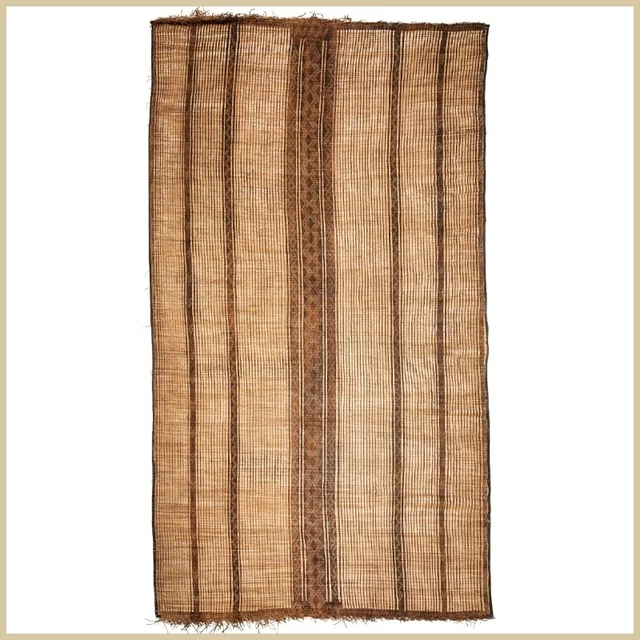
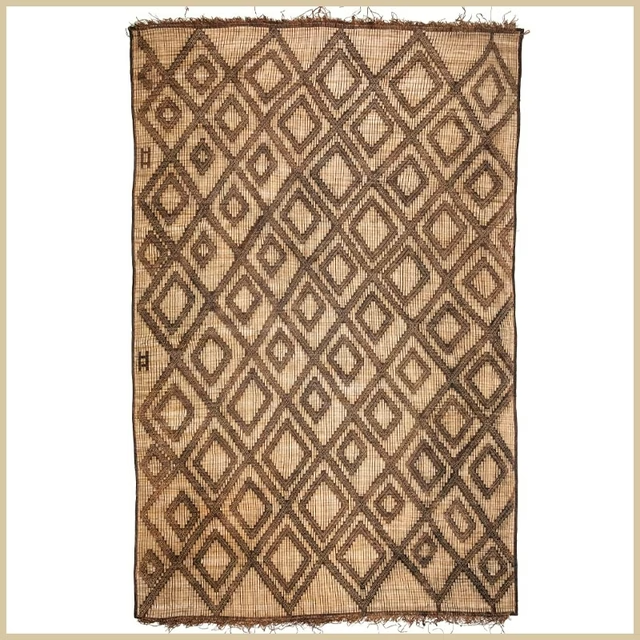
How a Tuareg mat is made
The body is plant fibre: stems of reed or of dwarf palm, cut to length and dried. They are laid parallel and tied to one another with narrow thongs of leather, row after row. Where the leather shows on the surface, it makes the design.
The patterns are geometric and precise: diamonds, crosses, stepped lines and borders, in the browns, blacks and reds of dyed leather against the straw colour of the stems. A large mat represents a great deal of work, and no two are the same.
Tuareg mat or wool rug
They are opposites in the hand. A wool rug is soft, warm and sound-absorbing. A Tuareg mat is hard, cool and smooth. It adds pattern and texture to a floor without any softness, and it sits flat under furniture.
The two combine well. A mat makes an excellent base layer, with a smaller wool rug on top where you want to sit. In a hot climate or a summer house, a mat alone is the more comfortable floor.
Where to use one
Use a Tuareg mat in a dry room with gentle traffic: a study, a bedroom, a dining room under a table, or a living room as a base layer. It is striking on a wall. Keep it away from bathrooms, kitchens and entrances, because moisture is its enemy.
It cannot be folded. Stems crack if they are bent sharply, so a mat is rolled along its length for moving and never creased. Put felt under furniture feet, and lift furniture onto the mat.
Care
Sweep or vacuum gently, in the direction of the stems. Wipe marks with a barely damp cloth and dry the place at once. Never soak a mat or leave it on a damp floor, since reeds mould and leather stiffens and cracks.
Leather benefits from an occasional, very light application of a neutral leather conditioner, tested first on a hidden corner. Keep the mat out of strong sun, which bleaches the stems and dries the leather. Old mats with broken bindings can be repaired by a specialist.
Tuareg mats and our collection
We do not sell Tuareg mats. Our collection is 275 hand-knotted wool rugs from Morocco, and the rugs shown on this page come from it. A mat of reed and leather is a different object and deserves a specialist dealer who can describe its age and condition.
If you are building a floor in layers, a wool rug is the natural partner for a mat. Ivory and sand sit especially well on straw tones: seventy-one of our rugs have an ivory or cream ground and thirty-seven are sand or taupe. Each rug is one of a kind, with its exact measurements on its own page. Delivery is free worldwide, duties and taxes included.
What you can verify about us
- Origin
- Made in MoroccoHand-knotted Berber rugs from the Atlas regions. Every rug is one of a kind.
- Construction
- Hand-knotted woolVerified at every stage — never machine-tufted.
- Delivery
- Duties includedFree shipping; import duties and taxes are included in the price.
- Returns
- 14 daysIn condition received, full refund of the purchase price.
Frequently Asked
Questions
- What is a Tuareg mat made of?
- Stems of reed or dwarf palm bound together with strips of leather.
- Can a Tuareg mat be used as a rug?
- Yes, in dry rooms with light traffic. It is firm and cool, not soft.
- How do you clean a Tuareg mat?
- Sweep or vacuum gently and wipe with a barely damp cloth. Never soak it.
- Do you sell Tuareg mats?
- No. We sell hand-knotted wool rugs.
Sources & References
What this page rests on
- 1. wikipedia — Tuareg people
- 2. entity_factsTuareg territory: southern Algeria, northern Mali, Niger, northeastern Burkina Faso
- 3. internal_researchReed-and-leather binding technique, distinct from Atlas wool weaving

The person behind the piece
“Before you buy, I’ll send you a video of the actual rug in natural light — not a stock photo. I answer the messages myself.”
I’m Youssef. I started ARINID because this market is full of middlemen and machine-made imitations sold as the real thing — and I grew up close enough to the looms to know the difference.
Every piece we list is one of a kind, hand-knotted in Morocco. If you want to talk through sizing for your room, I’m on the other end of the message. A rug at this level is a thirty-year decision. You should be able to look the person selling it to you in the eye.
Youssef
Founder, ARINID
The next step
See every rug we currently offer
Each piece is hand-knotted in Morocco and delivered to your door, with shipping, duties and taxes included.