
Glaoua Rug: Three Techniques in One Moroccan Rug
Last updated
A Glaoua rug is the technical showpiece of Moroccan weaving. It comes from the High Atlas south-east of Marrakech, the country historically associated with the Glaoua, around Telouet and towards Taznakht. Its mark is the combination of three techniques in a single textile: bands of knotted pile, bands of flat weave, and bands patterned in a wrapped, embroidery-like stitch. The result has a relief you can feel, with raised and flat zones alternating down the rug. This page explains how to recognise a Glaoua rug and how to use one and, since we do not stock them, what the nearest things in our collection are.
From the Atelier
Currently in our collection
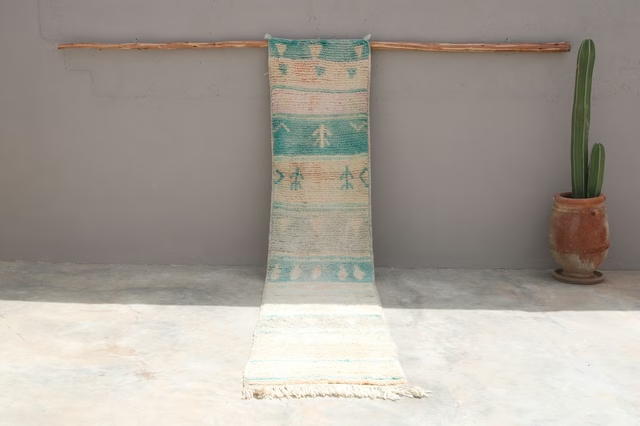
How to recognise a Glaoua rug
Run a hand along the rug. You will feel it change: a stripe of soft pile, then a smooth flat-woven stripe, then a stripe of fine raised pattern. Each technique carries its own motifs. The pile bands hold diamonds and larger shapes, and the flat bands hold small, precise figures.
Colours are often strong: black, white, red, saffron yellow, orange, sometimes blue. Many pieces are long and fairly narrow. The back shows the three structures clearly, which also makes a rug of this kind hard to imitate by machine.
Glaoua, Taznakht and neighbours
The region between the High Atlas and the Anti-Atlas, around the Siroua mountain, is one of the richest weaving areas of Morocco. Rugs from here are sold under several names: Glaoua or Glaoui, Taznakht, Aït Ouaouzguite. The labels overlap, and a mixed-technique piece may carry any of them.
What they share is fine wool, careful work and a taste for yellow and black alongside red. All-pile and all-flat rugs are made here too. The mixed-technique rug is simply the most distinctive product of the area.
Using one
Because it is partly flat, a Glaoua rug is thinner and lighter than an all-pile rug of the same size. It sits well in a hallway, a study or a bedroom, and under furniture. The alternation of textures is best appreciated where the rug is seen at length, down a corridor or beside a bed.
It needs a non-slip pad, like any light rug. The flat bands wear faster than the pile bands, so turn the rug regularly and keep it out of the heaviest traffic. Fine pieces are often hung, which shows the banding well.
Care
Vacuum with suction only, along the bands. The wrapped and flat sections can snag, so keep rotating brushes, pet claws and sharp chair legs away from them. Blot spills with cold water and a little wool detergent, and test strong colours for running before any wet cleaning.
A mixed-technique rug should be washed only by a specialist, because the different structures take up water and dry at different rates. Stored pieces need moth protection and should be rolled along the length, not folded.
The Glaoua rug and our collection
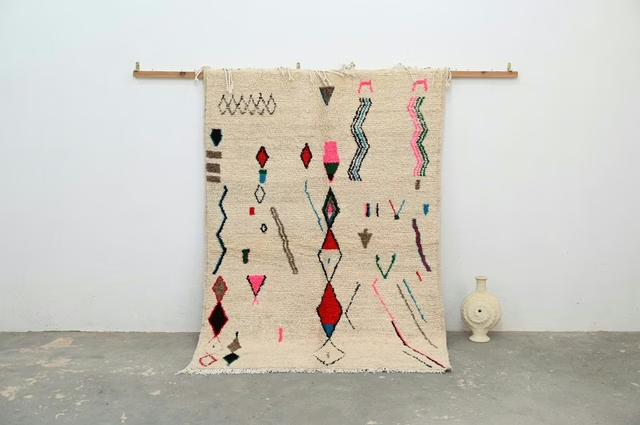
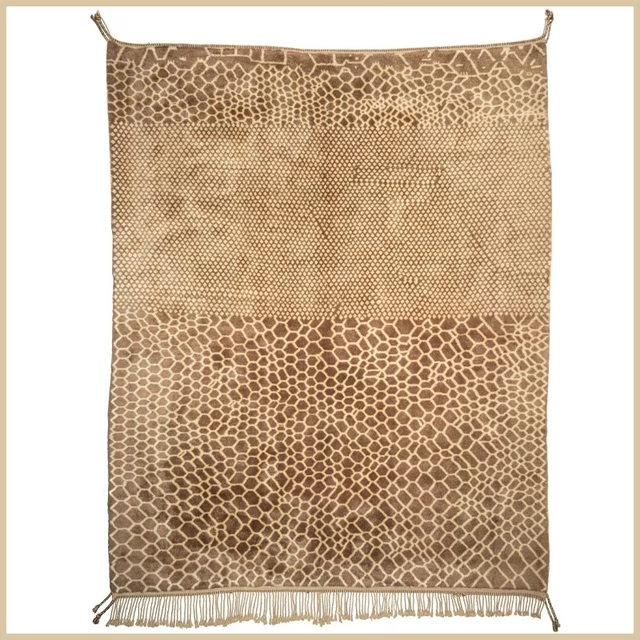
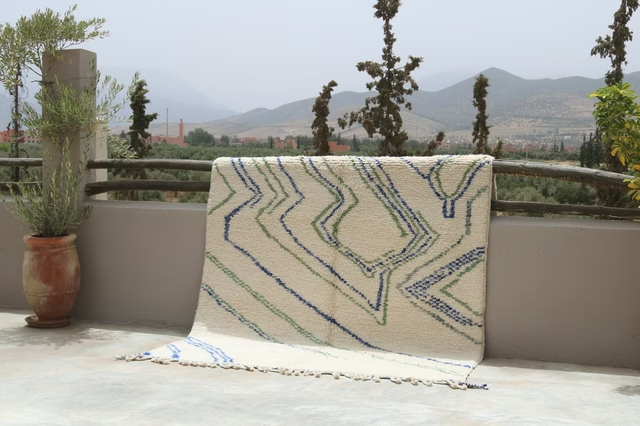
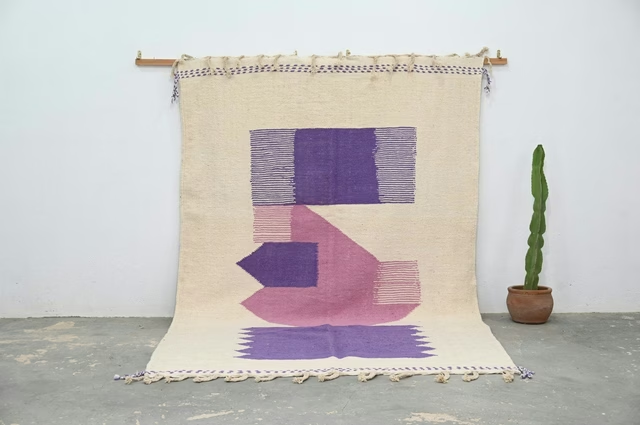
We hold no Glaoua rugs. Our collection is 275 hand-knotted pile rugs, and the rugs shown on this page come from it. We include this page so that the type is described properly, and so that nobody takes an all-pile rug for a mixed-technique one.
If the appeal is strong pattern in bands, look at the Azilal rugs, twenty-three of which are built on lines and bands, or at the Zanafi pattern in our bespoke studio. Each rug is one of a kind, with its exact measurements on its own page. Delivery is free worldwide, duties and taxes included.
What you can verify about us
- Origin
- Made in MoroccoHand-knotted Berber rugs from the Atlas regions. Every rug is one of a kind.
- Construction
- Hand-knotted woolVerified at every stage — never machine-tufted.
- Delivery
- Duties includedFree shipping; import duties and taxes are included in the price.
- Returns
- 14 daysIn condition received, full refund of the purchase price.
Frequently Asked
Questions
- What is a Glaoua rug?
- A Moroccan rug from the High Atlas that combines knotted pile, flat weave and wrapped patterning in one piece.
- Where do Glaoua rugs come from?
- From the High Atlas south-east of Marrakech, around Telouet and the Taznakht area.
- Are Glaoua rugs thick?
- Less so than all-pile rugs, because part of the surface is flat-woven.
- Do you sell Glaoua rugs?
- No. We sell hand-knotted pile rugs.
Sources & References
What this page rests on
- 1. Orit Ouaknine-Yekutieli — The Glaoua Tribe on River Seine (2024)Academic study of the Glaoua dynasty and its representation in French colonial discourse.
- 2. Center of Judeo-Moroccan Culture — Famille berbère dans le Glaoua — historical photographDocumentary photograph of Glaoua Berber family from the Judeo-Moroccan archive.
- 3. Bruno Barbatti — textile historian — Tapis du Maroc — Le langage des symboles (1996) — Scheidegger & SpiessThe reference work on the symbolic vocabulary of Berber rug motifs.
- 4. Prosper Ricard — French Protectorate ethnographer — Corpus des tapis marocains (1923) — Service des Arts Indigènes (1923–1934)The first systematic Western catalogue of Moroccan rug types. Still the working taxonomy.

The person behind the piece
“Before you buy, I’ll send you a video of the actual rug in natural light — not a stock photo. I answer the messages myself.”
I’m Youssef. I started ARINID because this market is full of middlemen and machine-made imitations sold as the real thing — and I grew up close enough to the looms to know the difference.
Every piece we list is one of a kind, hand-knotted in Morocco. If you want to talk through sizing for your room, I’m on the other end of the message. A rug at this level is a thirty-year decision. You should be able to look the person selling it to you in the eye.
Youssef
Founder, ARINID
The next step
See every rug we currently offer
Each piece is hand-knotted in Morocco and delivered to your door, with shipping, duties and taxes included.