
Vintage Rug: Real Age, Patina and the Vintage Look
Last updated
The vintage rug has become a category of its own, and the word covers three very different things. There is the rug that is truly old, made decades ago and softened by use. There is the new rug whose colours were chosen faded on purpose. And there is the factory rug with wear printed onto it. The first two have their appeal; the third has little. This guide shows how to tell them apart, what patina does in a room, and what you will find here: a small selection of Berber wool rugs in softened tones, with no invented history attached.
From the Atelier
Vintage Rug currently in our collection 7
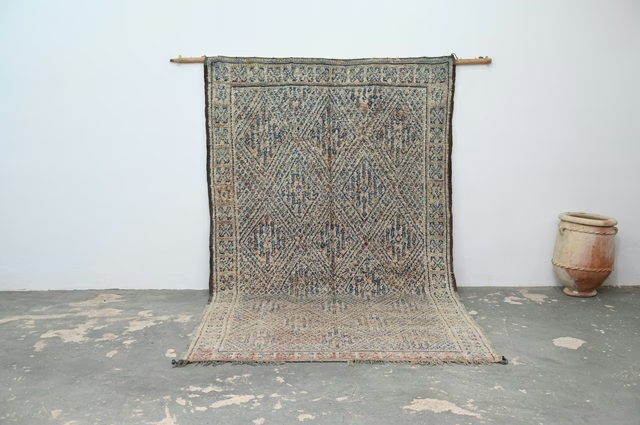
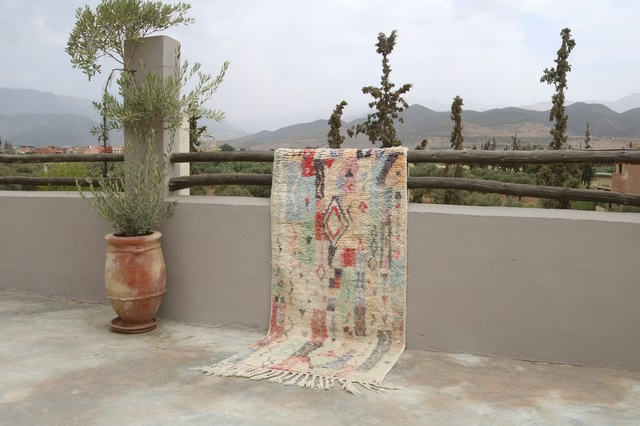
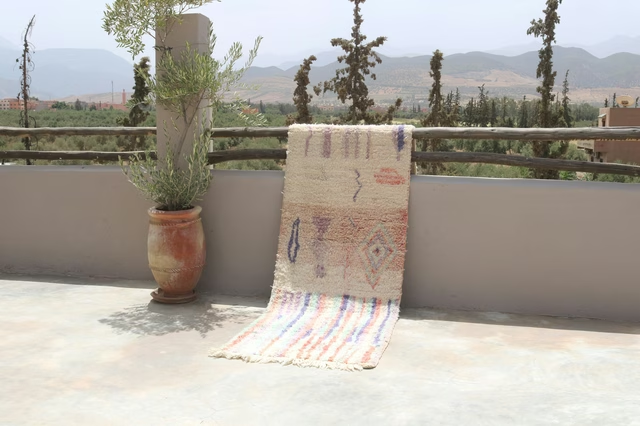
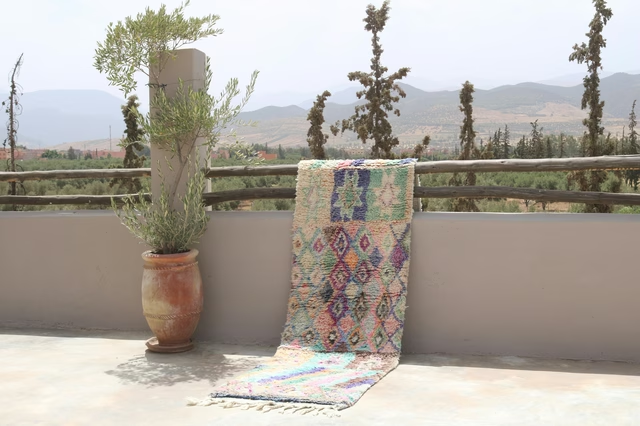
Vintage, antique, distressed
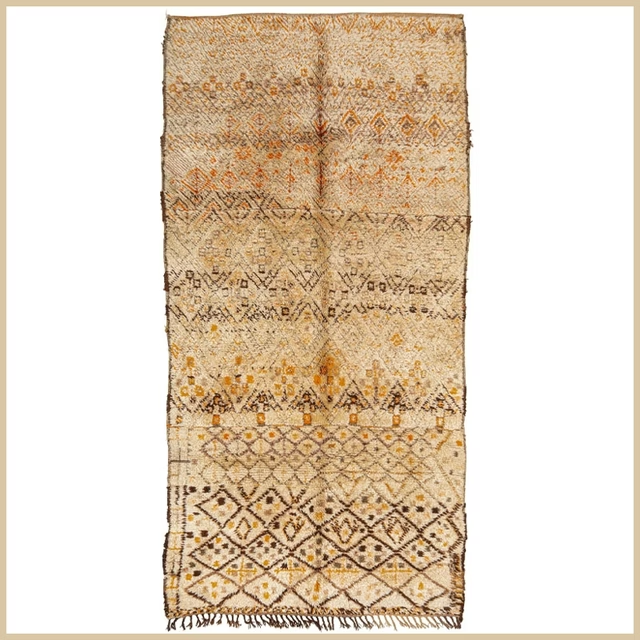
In the rug trade, antique means a hundred years old or more, and vintage means a few decades. A real vintage piece has been used. The wool has settled, the colours have run into one another, and the edges sometimes carry repairs. That lived life is its charm, and the reason such pieces are scarce.
A distressed rug is another matter. It is new, but washed, sheared or bleached to imitate age, or overdyed in a fashionable colour on top of an old design. The vintage-look rug in a furniture chain is a print on synthetic fibre. None of this is dishonest as long as it is stated. The trouble starts when the word vintage sells new goods at the price of old.
How to recognise a rug that is really old
Turn it over. On a hand-knotted rug the design can be read on the back, knot by knot. On a piece that has had a life, the back is smooth and the knots are flattened by years of footsteps. Wear in the pile is uneven: heavier in the middle and along the walkways, lighter at the edges and where furniture stood.
Then part the pile and look at the colour near the base. On a rug faded by light, the tips are paler than the roots. On chemically bleached goods the tone is evenly pale the whole way down. Be wary of round dimensions and of rugs offered in several sizes. A genuinely old piece exists once.
What patina does in a room
A rug with faded colours can do something a rug in fresh tones cannot: it looks as though it has always been there. In a newly renovated home with white walls and sharp lines, it is often the element that takes away the showroom feeling.
Washed-out tones are also very tolerant. A pink that has become dusty rose, a blue gone grey, an ochre that has mellowed all get on with each other and with nearly everything else: old or pale timber, linen, leather, black metal. The drawing no longer pushes itself forward. Contemporary furniture can stand on it without anything competing for attention.
Getting the vintage feeling from a new rug
If what you want is not a rug that is decades old but the calm that comes from one, a new hand-knotted piece in muted colours will give it to you. The material decides. Wool grows better looking with the years. The pile settles, the colours soften, and the rug acquires a patina of its own.
A printed synthetic rug with a vintage look travels the opposite road. It looks old on the first day and worn out after three years, because the pile lies flat and the print has rubbed away along the walkways. The real choice is less between old and new than between a material that can age and one that cannot.
Our selection, without a legend
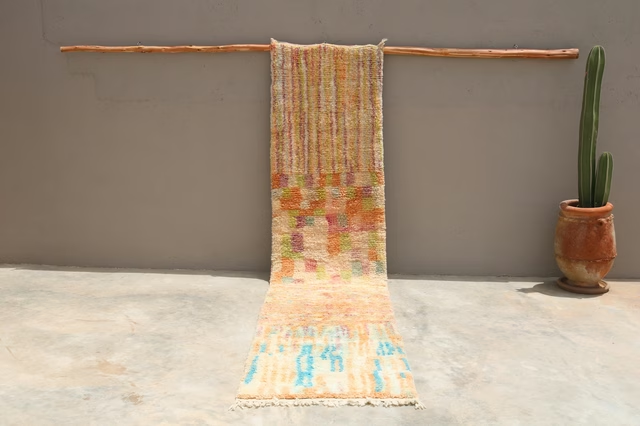
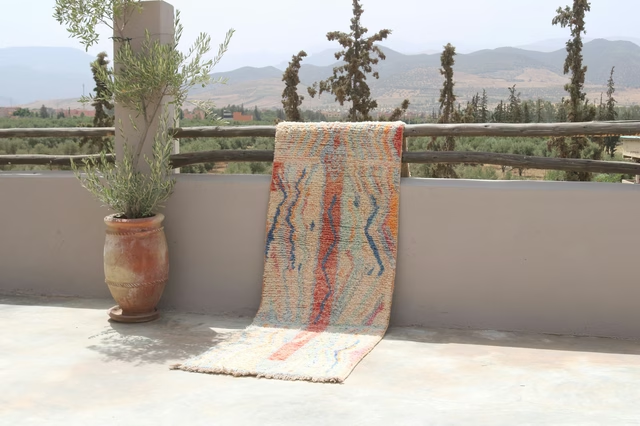
We do not sell these rugs as antiques. The selection gathers pieces with a faded palette and a softened drawing: mostly Azilal runners about 2 ft 7 in to 3 ft wide and 10 ft or more long, in washed pink, blue, sage and ochre. With them are two larger rugs with dimmed diamonds on a pale ground, one of which shows the marks of long use.
All are wool and knotted by hand, each one of a kind with its measured size on its page. It is a small selection and it changes. Delivery is free worldwide, duties and taxes included.
What you can verify about us
- Origin
- Made in MoroccoHand-knotted Berber rugs from the Atlas regions. Every rug is one of a kind.
- Construction
- Hand-knotted woolVerified at every stage — never machine-tufted.
- Delivery
- Duties includedFree shipping; import duties and taxes are included in the price.
- Returns
- 14 daysIn condition received, full refund of the purchase price.
Frequently Asked
Questions
- What is the difference between a vintage rug and an antique rug?
- Antique refers to pieces a hundred years old or more, vintage to pieces a few decades old. In both cases a rug that has actually been used is meant, not a new rug made to look aged.
- How can I tell whether a vintage rug is genuine?
- Check the back, which should be smooth and polished by use, the wear, which should be uneven, and the colour at the base of the pile, which is stronger than at the surface on a light-faded piece. A real one exists only once.
- Are vintage rugs fragile?
- An old hand-knotted rug in good condition is sturdy, but it asks for more consideration: a rug pad, vacuuming without a beater bar and washing by a specialist. Thinned pieces should be kept out of busy areas.
- Can I get a vintage look with a new rug?
- Yes, with a hand-knotted wool rug in muted colours and a quiet design. Over the years it develops its own patina, which a printed synthetic rug cannot do.
Sources & References
What this page rests on
- 1. Metropolitan Museum of Art (New York) — Hanging (Arid), ca. 1800 — linen and silk plain weaveMet collection holding of c.1800 Arid weaving — precursor textile tradition to documented Berber rugs.
- 2. Bruno Barbatti — textile historian — Tapis du Maroc — Le langage des symboles (1996) — Scheidegger & SpiessThe reference work on the symbolic vocabulary of Berber rug motifs.
- 3. Prosper Ricard — French Protectorate ethnographer — Corpus des tapis marocains (1923) — Service des Arts Indigènes (1923–1934)The first systematic Western catalogue of Moroccan rug types. Still the working taxonomy.
- 4. Cynthia Becker — Boston University — Amazigh Arts in Morocco: Women Shaping Berber Identity (2006) — University of Texas PressAnthropological study of Atlas weaving as Amazigh women's craft tradition.
- 5. Leigh Minturn — The Economic Importance and Technological Complexity of Hand-Spinning and Hand-Weaving (1996)Cross-cultural anthropological study of hand-spinning and hand-weaving labour.

The person behind the piece
“Before you buy, I’ll send you a video of the actual rug in natural light — not a stock photo. I answer the messages myself.”
I’m Youssef. I started ARINID because this market is full of middlemen and machine-made imitations sold as the real thing — and I grew up close enough to the looms to know the difference.
Every piece we list is one of a kind, hand-knotted in Morocco. If you want to talk through sizing for your room, I’m on the other end of the message. A rug at this level is a thirty-year decision. You should be able to look the person selling it to you in the eye.
Youssef
Founder, ARINID
The next step
See every rug we currently offer
Each piece is hand-knotted in Morocco and delivered to your door, with shipping, duties and taxes included.