
Zemmour Rug: Red Banded Weavings from Northern Morocco
Last updated
A Zemmour rug comes from the Zemmour, a confederation of tribes in the country between Rabat and Meknes, around Khemisset and Tiflet. Their weaving is among the most recognisable in Morocco: a red ground, crossed by band after band of small, precise geometric figures in white, black, yellow and orange. The Zemmour are known above all for flat weaves, and they also made pile rugs in the same red, banded manner. This page describes both, explains how they differ from the better-known rugs of the Atlas, and says plainly that we do not stock them.
From the Atelier
Currently in our collection
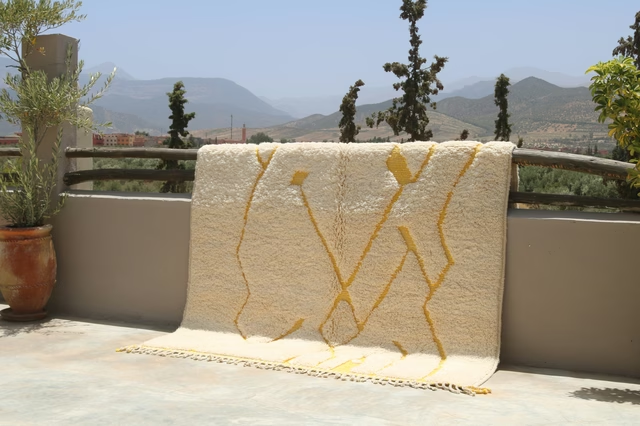
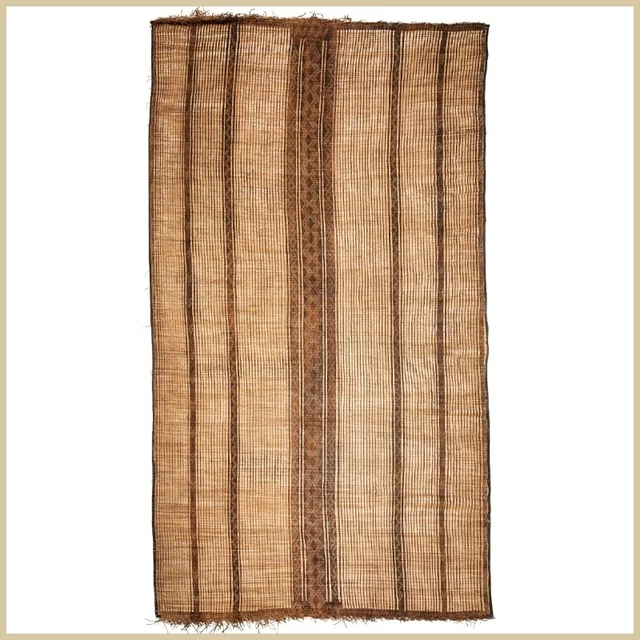
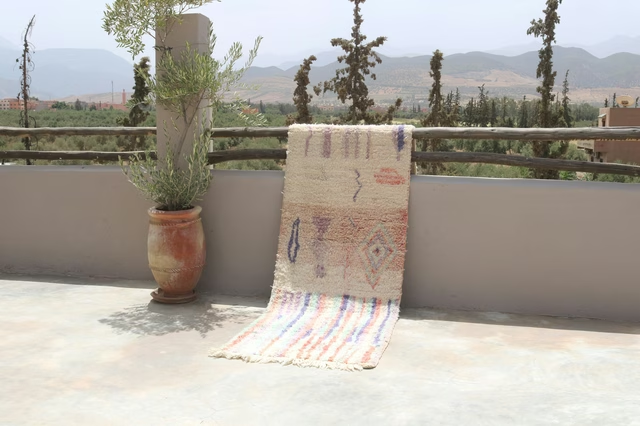
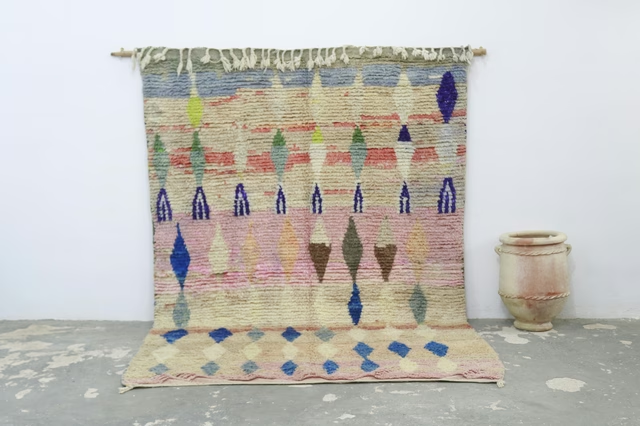
What defines Zemmour weaving
Red, and order. The ground ranges from brick to a deep, slightly blue red. Across it run horizontal bands, some plain, some filled with rows of tiny diamonds, triangles, zigzags and chequer patterns. The bands repeat with small variations from one end to the other.
The flat weaves are fine and firm, with the pattern standing in slight relief. The pile rugs carry the same banding, or a lattice of diamonds on red. In both, the drawing is tighter and more regular than in rugs from the Atlas.
How a Zemmour rug differs from Atlas rugs
Set a Zemmour piece beside a Beni Ourain and they could come from different countries. One is ivory, loose and almost empty. The other is red, close-patterned and disciplined. Beside an Azilal, the Zemmour looks calm for all its detail, because the bands impose a rhythm.
The nearest relatives in colour are Beni Mguild and Boujaad rugs, both red. A Beni Mguild is deeper in pile and sparser in pattern. A Boujaad is pinker and far freer. The Zemmour is the most architectural of the three.
Using a red banded rug
A Zemmour rug suits rooms that can take pattern and warmth: a library, a dining room, a hallway, a bedroom with white walls. Bands running across a narrow room make it look wider. Red hides marks, and fine pattern hides nearly everything.
Pair it with plain upholstery in cream, tan, olive or navy, and with dark wood. Avoid other small-scale patterns close by. The flat weaves work beautifully as wall hangings and bed covers, and many were made to be used as covers.
Buying and care
Older Zemmour pieces are collected, and newer ones are still made. Look at the fineness and evenness of the bands, at the condition of the ends and edges, and at the red: a good one is deep and slightly varied, not flat. Ask whether the piece is flat-woven or pile, and what it measures.
Vacuum with suction only, along the bands. Test the red for running with a damp white cloth before any wet cleaning. Keep it out of strong sun. Flat weaves need a non-slip pad on the floor, and moth protection when stored.
Zemmour rugs and our collection
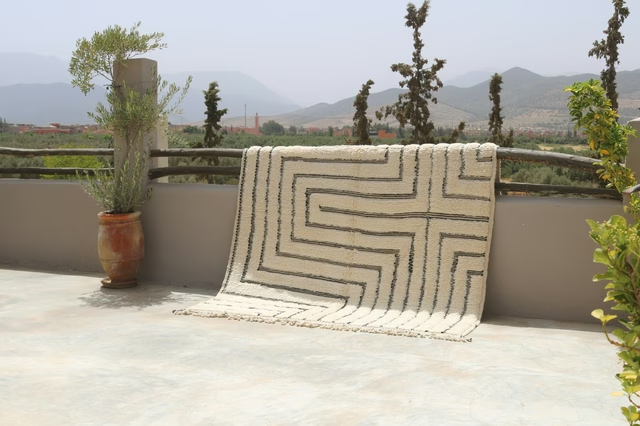
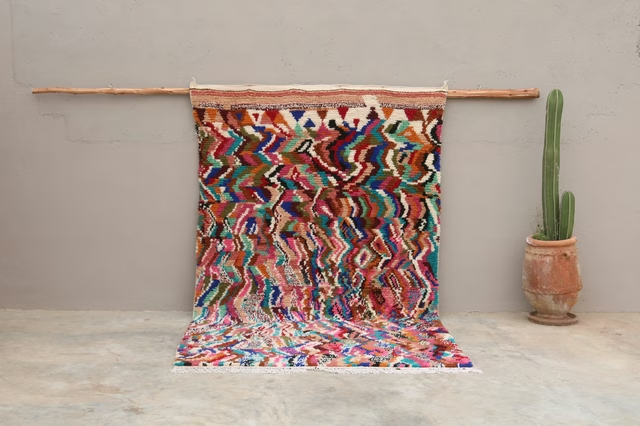
We hold no Zemmour rugs. Our collection is 275 hand-knotted pile rugs from the Atlas traditions, and the rugs shown on this page come from it. For red, the collection has seven rugs in burgundy and wine and twelve in terracotta and coral.
The six burgundy Beni Mguild rugs and the two Boujaad pieces are the closest in spirit. Each rug is one of a kind, with its exact measurements on its own page. Delivery is free worldwide, duties and taxes included.
What you can verify about us
- Origin
- Made in MoroccoHand-knotted Berber rugs from the Atlas regions. Every rug is one of a kind.
- Construction
- Hand-knotted woolVerified at every stage — never machine-tufted.
- Delivery
- Duties includedFree shipping; import duties and taxes are included in the price.
- Returns
- 14 daysIn condition received, full refund of the purchase price.
Frequently Asked
Questions
- What is a Zemmour rug?
- A rug or flat weave from the Zemmour tribes of northern Morocco, with a red ground and bands of fine geometric pattern.
- Are Zemmour rugs flat-woven or pile?
- Both exist. The flat weaves, often called hanbels, are the better known.
- Where is the Zemmour region?
- Between Rabat and Meknes, around Khemisset and Tiflet.
- Do you sell Zemmour rugs?
- No. The closest pieces we hold are red Beni Mguild and Boujaad rugs.
Sources & References
What this page rests on
- 1. wikipedia — Moroccan rugs
- 2. entity_factsKhémisset Province, central Middle Atlas plateau
- 3. internal_researchMadder dye chemistry and ageing

The person behind the piece
“Before you buy, I’ll send you a video of the actual rug in natural light — not a stock photo. I answer the messages myself.”
I’m Youssef. I started ARINID because this market is full of middlemen and machine-made imitations sold as the real thing — and I grew up close enough to the looms to know the difference.
Every piece we list is one of a kind, hand-knotted in Morocco. If you want to talk through sizing for your room, I’m on the other end of the message. A rug at this level is a thirty-year decision. You should be able to look the person selling it to you in the eye.
Youssef
Founder, ARINID
The next step
See every rug we currently offer
Each piece is hand-knotted in Morocco and delivered to your door, with shipping, duties and taxes included.