
Boucherouite Rug: The Moroccan Rag Rug Explained
Last updated
A boucherouite rug is a Moroccan rag rug. In place of wool yarn, the weaver knots or weaves strips torn from worn-out clothing and household textiles: cotton, synthetics, wool, whatever is to hand. The name comes from a Moroccan Arabic expression for a scrap of used cloth. The result is the most colourful and the most unpredictable of all Moroccan rugs, a patchwork of every shade the scrap pile offered. This page explains what a boucherouite is, where it works in a home, how to look after one and, to be straightforward about it, why we do not sell them.
From the Atelier
Currently in our collection
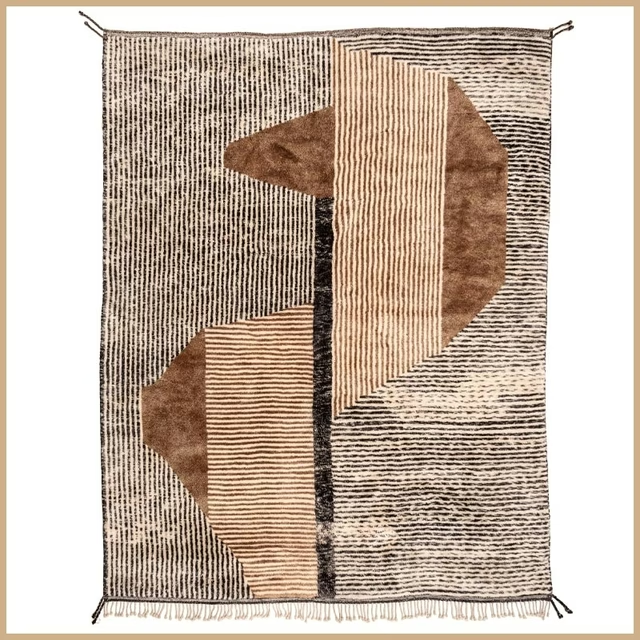
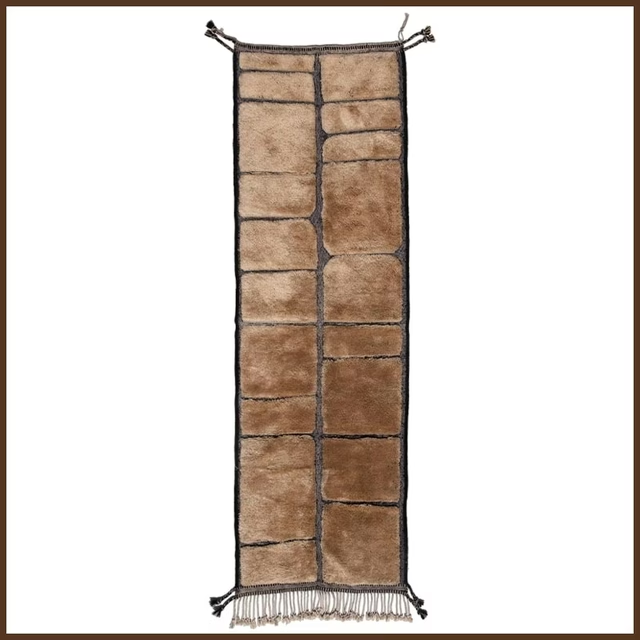
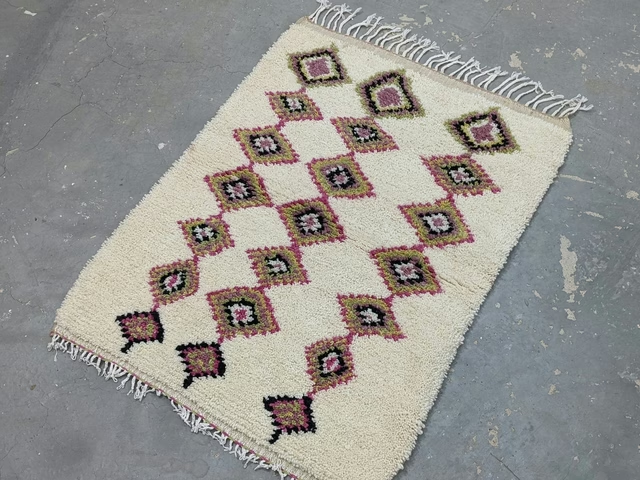
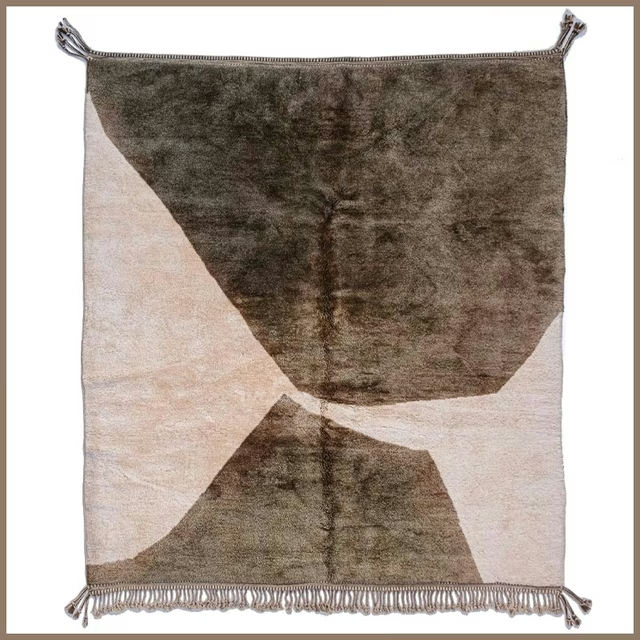
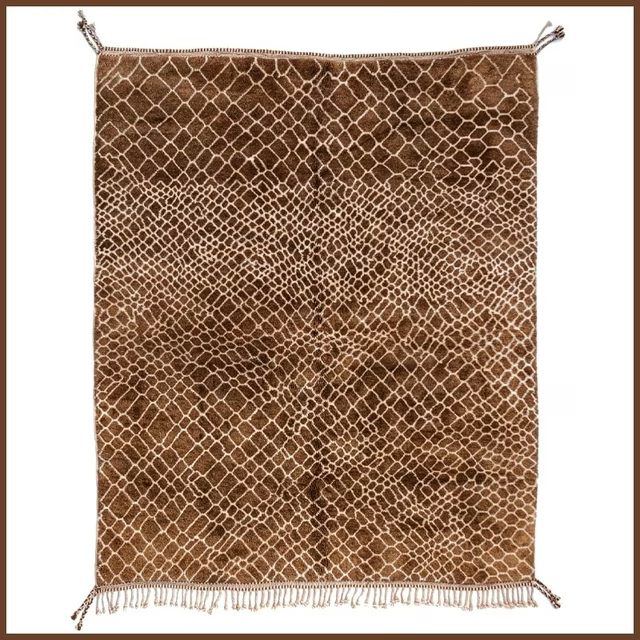
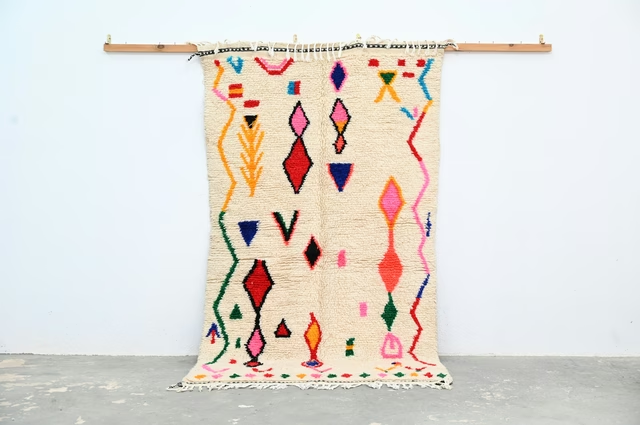
What a boucherouite rug is
It is usually explained as a product of thrift. Rural households that had less wool to spare, and more factory-made clothing wearing out, turned old garments into rugs for their own homes. The technique is the familiar one, knots on a loom, but each knot is a strip of fabric and not a tuft of yarn.
Because the material is whatever was available, no two are alike in colour, thickness or handle. One may be mostly cotton, another full of nylon and metallic thread. Patterns are bold and loose: diamonds, zigzags, stripes and blocks, in clashing brights. Sizes are usually small.
Where a boucherouite works
It is an accent, and a strong one. A boucherouite brings a shot of colour to a white bathroom, a child's room, a kitchen, a hallway or the foot of a bed. Many people hang them on the wall, where they read as textile art.
It is not a rug for the centre of a large living room: the sizes are too small and the surface too uneven. Layered over a large plain rug, or used singly on a bare floor with a non-slip pad, it does what nothing else does.
Care
Care depends on what the rug is made of, and that is rarely known. Cotton-based pieces tolerate water better than wool does. Synthetic strips can be damaged by heat. Colours from old dyed clothing may run. Shake the rug out regularly, and vacuum it gently with suction only.
For anything more, test a small area with cold water and a white cloth before washing, and avoid hot water and tumble drying. Rag pile sheds lint and threads, especially when the rug is new to you. Trim loose ends with scissors and do not pull them.
Boucherouite and wool rugs compared
A wool pile rug, such as an Azilal, is springy, warm and even underfoot, and it wears slowly. A boucherouite is flatter in some places and lumpier in others, cooler to the touch and less resilient, because strips of cloth do not spring back as wool does.
What the boucherouite offers in return is a kind of colour that wool rugs seldom reach, and the charm of reuse. If you like its spirit but want a wool rug for daily use in a main room, a multicoloured Azilal is the nearest thing.
Why we do not sell them
Our collection is hand-knotted wool only, and a boucherouite is by definition not that. We hold none, and would rather say so on this page than show you wool rugs under a boucherouite heading without comment. For a genuine one, look for a dealer who specialises in them and who states the materials.
The rugs shown on this page come from our collection of 275 wool rugs. If it is the colour you are after, seventy-eight of them are multicoloured, most of them Azilal. Each rug is one of a kind, with its exact measurements on its own page. Delivery is free worldwide, duties and taxes included.
What you can verify about us
- Origin
- Made in MoroccoHand-knotted Berber rugs from the Atlas regions. Every rug is one of a kind.
- Construction
- Hand-knotted woolVerified at every stage — never machine-tufted.
- Delivery
- Duties includedFree shipping; import duties and taxes are included in the price.
- Returns
- 14 daysIn condition received, full refund of the purchase price.
Frequently Asked
Questions
- What is a boucherouite rug?
- A Moroccan rag rug made by knotting or weaving strips of recycled fabric in place of wool yarn.
- What does boucherouite mean?
- It comes from a Moroccan Arabic expression for a piece of torn, used cloth.
- Can you wash a boucherouite rug?
- It depends on the fabrics in it. Test with cold water first and avoid heat.
- Do you sell boucherouite rugs?
- No. We sell hand-knotted wool rugs. A multicoloured Azilal is the closest in spirit.
Sources & References
What this page rests on
- 1. World Museum Vienna (Weltmuseum) — Boucherouite / "Fetzenteppich" — accession VO_188636Documented Boucherouite rug in the Weltmuseum Wien ethnographic collection.
- 2. World Museum Vienna (Weltmuseum) — Boucherouite / "Fetzenteppich" — accession VO_188643Second documented Boucherouite in the Weltmuseum Wien collection.
- 3. Victoria & Albert Museum (London) — Moroccan textile collection — includes BoucherouiteV&A holds documented Moroccan textiles including Boucherouite examples.
- 4. Vitra Design Museum (Weil am Rhein) — Boucherouite — 2008 exhibitionMajor 2008 exhibition that established Boucherouite as design-collected category.
- 5. Gebhart Blazek — Berber-arts.com — private collection and museum exhibition curator — Berber-arts.comAustrian collector and researcher; collection underlies multiple museum exhibitions.
- 6. Wikidata — Boucherouite (Q3640749)

The person behind the piece
“Before you buy, I’ll send you a video of the actual rug in natural light — not a stock photo. I answer the messages myself.”
I’m Youssef. I started ARINID because this market is full of middlemen and machine-made imitations sold as the real thing — and I grew up close enough to the looms to know the difference.
Every piece we list is one of a kind, hand-knotted in Morocco. If you want to talk through sizing for your room, I’m on the other end of the message. A rug at this level is a thirty-year decision. You should be able to look the person selling it to you in the eye.
Youssef
Founder, ARINID
The next step
See every rug we currently offer
Each piece is hand-knotted in Morocco and delivered to your door, with shipping, duties and taxes included.