Antique Rug: What the Word Means and How to Buy One Wisely
Last updated
An antique rug is, by the usual convention of the trade, one that is about a hundred years old or older. Rugs between roughly thirty and a hundred years old are called vintage, and the older ones among those are sometimes labelled semi-antique. The words matter because age changes how a rug is valued and how it should be used, and because they are applied far more freely than the facts allow. This page explains how the age of a rug is judged, what to look at before buying, and why we do not sell any of our rugs as antique.
From the Atelier
Currently in our collection
How the age of a rug is judged
There is rarely a document. Age is estimated from the object itself: the materials, the dyes, the structure, the design and the pattern of wear. Specialists compare a rug with dated examples in collections and in the literature, and even they give ranges and not years.
For Moroccan rugs the difficulty is greater. They were made for use in the home and were used until they wore out, so pieces of great age are scarce. Many rugs offered as antique Moroccan turn out to date from the middle of the twentieth century. That makes them vintage, which is no bad thing, but it is not the same claim.
Signs of real age, and of artificial age
Honest wear is uneven. The pile is lower where people walked and fuller at the edges and where furniture stood. The back is smooth and slightly polished. Colours have softened from the surface down, so the base of the pile is stronger in colour than the tips.
Artificial ageing leaves different traces. A rug that has been chemically washed or bleached in the sun is faded evenly all over, the back included. Pile shaved to imitate wear is the same height everywhere. Fringes are cut ragged while the body looks fresh. If a rug looks uniformly old, ask how it came to look that way.
Condition: what to check before you buy an antique rug
Look at the foundation first. Bend a section of the rug gently, pile outwards. Cracking sounds or stiffness point to dry rot, which cannot be cured. Check for holes, old repairs and reweaving, which show on the back as areas of different texture. Check both ends and both edges, since these are the first to go.
Then decide what the rug is for. A fragile old piece belongs on a wall or in a room with little traffic. If you want a rug for a family living room, an old one in sound condition is a better buy than an older one in poor condition, and a new hand-knotted rug may serve better than either.
Buying safely
Buy from someone who will put the description in writing: estimated age as a range, origin, materials, condition and any repairs. For an important piece, an independent appraisal is worth having. Be wary of precise dates without evidence, of stories about the weaver, and of the word antique used as the name of a style.
Remember the practical side as well. Old rugs may need washing by a specialist before they come into the house, and may carry moth eggs if they have been stored. Some countries restrict the export of old textiles. None of this should put you off a rug you love. It is simply the homework.
Why we do not sell rugs as antique
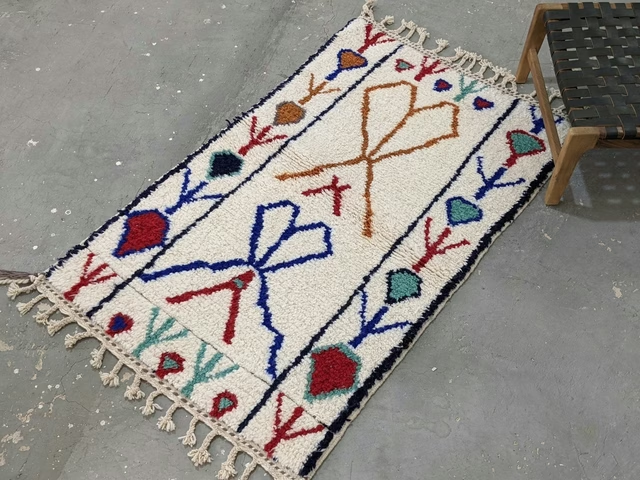
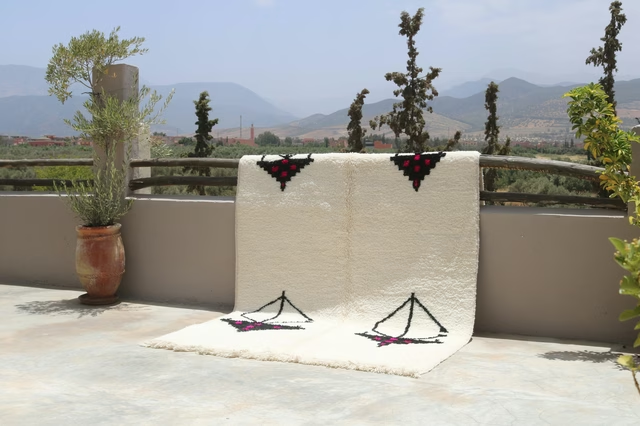
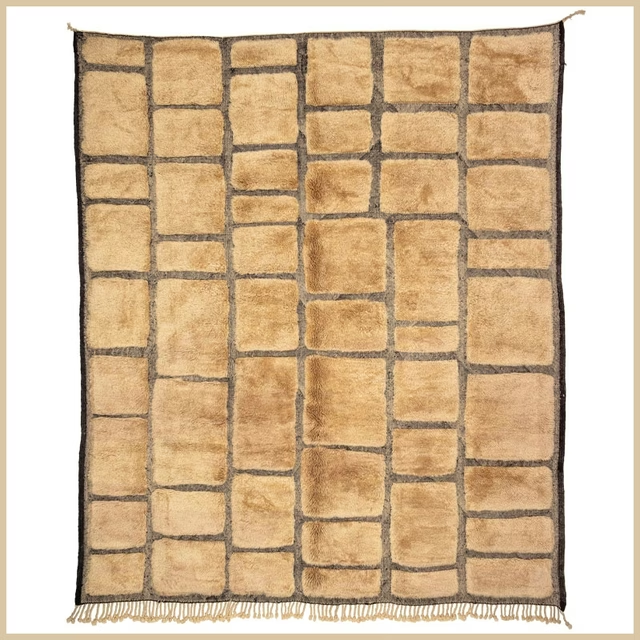
Our collection is 275 hand-knotted wool rugs from Morocco, and we describe them by what we can verify: type, size, colour and pattern. We do not date them. One piece is listed as vintage, and seven rugs are in faded, vintage-looking tones. None is offered as an antique.
If what draws you to antique rugs is the softened colour and the irregular drawing, a hand-knotted rug made recently in a long-established design gives you both, with a full pile and decades of use ahead of it. Each rug is one of a kind, with its exact measurements on its own page. Delivery is free worldwide, duties and taxes included.
What you can verify about us
- Origin
- Made in MoroccoHand-knotted Berber rugs from the Atlas regions. Every rug is one of a kind.
- Construction
- Hand-knotted woolVerified at every stage — never machine-tufted.
- Delivery
- Duties includedFree shipping; import duties and taxes are included in the price.
- Returns
- 14 daysIn condition received, full refund of the purchase price.
Frequently Asked
Questions
- How old does a rug have to be to be antique?
- About a hundred years, by trade convention. Roughly thirty to a hundred years is called vintage.
- How can I tell if a rug is really antique?
- Look for uneven wear, a smooth back and colour that is stronger at the base of the pile. For certainty, ask a specialist appraiser.
- Are antique rugs good for everyday use?
- Only if the foundation is sound. Fragile pieces are better on a wall or in rooms with little traffic.
- Do you sell antique Moroccan rugs?
- No. We do not date our rugs or offer any of them as antique.
Sources & References
What this page rests on
- 1. Metropolitan Museum of Art (New York) — Hanging (Arid), ca. 1800 — linen and silk plain weaveMet collection holding of c.1800 Arid weaving — precursor textile tradition to documented Berber rugs.
- 2. Musée du Quai Branly — Jacques Chirac (Paris) — Berber and North African textile collectionMajor French museum holding of Berber and Maghreb weaving traditions.
- 3. Prosper Ricard — French Protectorate ethnographer — Corpus des tapis marocains (1923) — Service des Arts Indigènes (1923–1934)The first systematic Western catalogue of Moroccan rug types. Still the working taxonomy.
- 4. Bruno Barbatti — textile historian — Tapis du Maroc — Le langage des symboles (1996) — Scheidegger & SpiessThe reference work on the symbolic vocabulary of Berber rug motifs.

The person behind the piece
“Before you buy, I’ll send you a video of the actual rug in natural light — not a stock photo. I answer the messages myself.”
I’m Youssef. I started ARINID because this market is full of middlemen and machine-made imitations sold as the real thing — and I grew up close enough to the looms to know the difference.
Every piece we list is one of a kind, hand-knotted in Morocco. If you want to talk through sizing for your room, I’m on the other end of the message. A rug at this level is a thirty-year decision. You should be able to look the person selling it to you in the eye.
Youssef
Founder, ARINID
The next step
See every rug we currently offer
Each piece is hand-knotted in Morocco and delivered to your door, with shipping, duties and taxes included.