Nursery Rug: Choosing a Wool Rug for a Baby's Room
Last updated
A nursery rug is used differently from any other rug in the house. For the first months it is mostly yours: you kneel on it at changing time, pace across it at three in the morning and sit on it with your back against the crib. Then the baby takes over, first for tummy time, then for crawling, then for everything. So the rug has to be comfortable for adult knees, safe for small hands and realistic to keep clean. This page covers size, pile, safety and colour, and says plainly what a hand-knotted wool rug can and cannot do in a baby's room.
From the Atelier
Currently in our collection
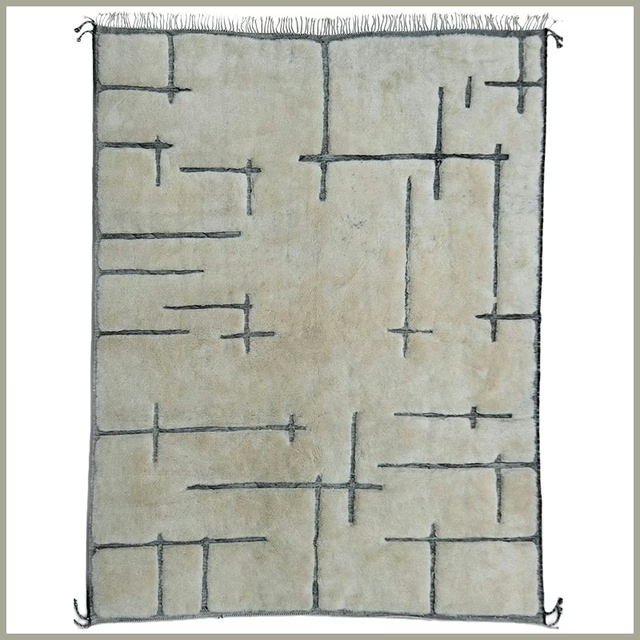
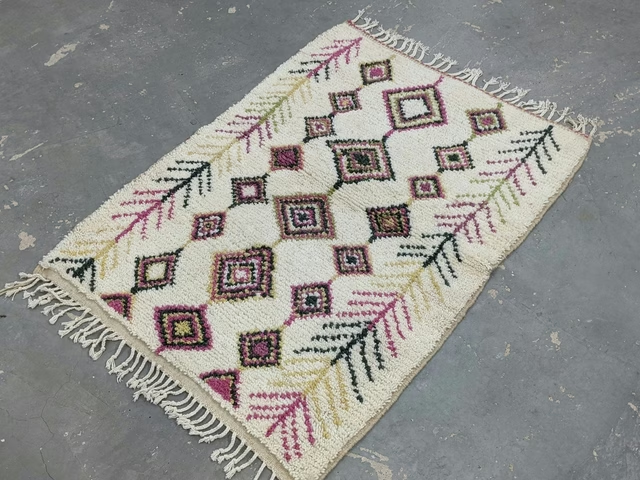
What a nursery rug has to do
Three jobs. The first is comfort, because in a nursery the floor is furniture. You will sit, kneel and lie on it far more than in any other room of the house. Wool pile is springy and feels warm to the touch even over a cold, hard floor.
The second is quiet. A room with a hard floor and little furniture echoes, and footsteps carry. A dense rug absorbs part of that, which matters when you are trying to leave the room without waking anyone. The third is a softer place to land once sitting up turns into toppling over. A rug cushions a tumble from sitting height. It is not a safety mat and should not be treated as one.
What size nursery rug
Decide first whether the crib will stand on the rug. Either put all four legs on it or keep the crib off it entirely. Two legs on and two off leaves the crib uneven. The same goes for a glider or a rocking chair: fully on, or fully off.
In a small nursery of about 9 by 10 feet, a 4x6 or 5x8 rug in the open centre of the room, clear of the crib, gives the most usable floor. In a larger room an 8x10 can run under the crib and the chair and still leave a border of bare floor around the edge. Check the door as well. It has to swing over the pile without catching.
Wool in a baby's room, honestly
Wool has real advantages here. The surface of the fibre makes liquid sit on top for a short while before it soaks in, which gives you time to blot a spill. The pile springs back after being sat on, and it feels warm.
It also has limits you should know before buying. A hand-knotted wool rug cannot go in a washing machine. A new one sheds loose fibre for the first months, so plan to vacuum two or three times a week, with suction only, while a baby is on the floor. Accidents need blotting at once with cold water and a little wool detergent. We make no health claims for our rugs. If your family has a known sensitivity to wool, speak to your doctor first.
Laying a nursery rug safely
Put a non-slip pad under the rug, cut slightly smaller than the rug itself. You will be carrying a baby across it, often in the dark, and a rug that slides on a hard floor is a hazard. A pad also helps keep the corners down. If a corner still lifts, flatten it before the room goes into use.
Then look at the pile with a crawler's eyes. A long, shaggy pile hides small objects, so run a hand through it now and then. A denser pile is easier to keep clear and easier to crawl on. Many Moroccan rugs have a fringe at one end, and babies pull at it, so turn that end towards the wall or tuck it under a piece of furniture. Keep the rug clear of heaters, and fix tall furniture to the wall whatever is on the floor.
Colour, pattern and the rugs we hold
A nursery rug outlasts the nursery. Themed rugs are outgrown in a few years, while a good wool rug moves on to a child's bedroom and later a study. Ivory is the calm choice and shows marks soonest. A patterned or multicoloured rug forgives far more, and gives a baby something to look at.
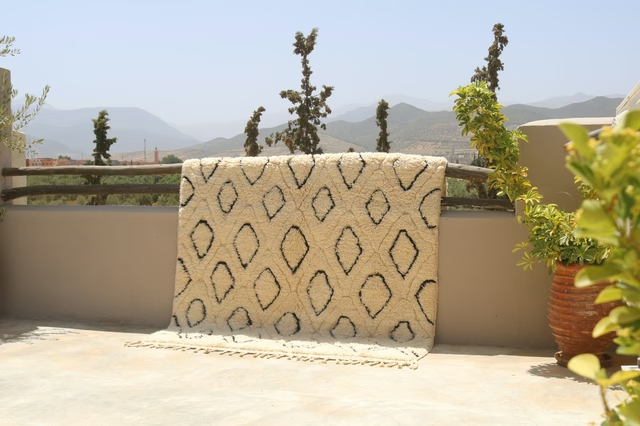
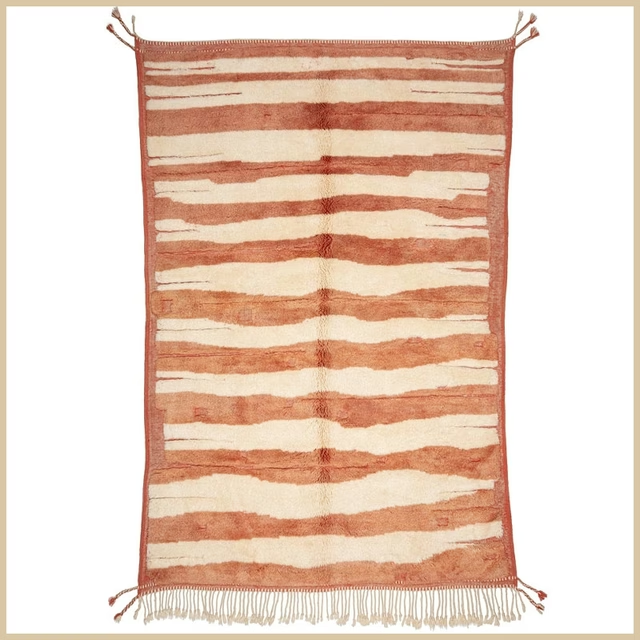
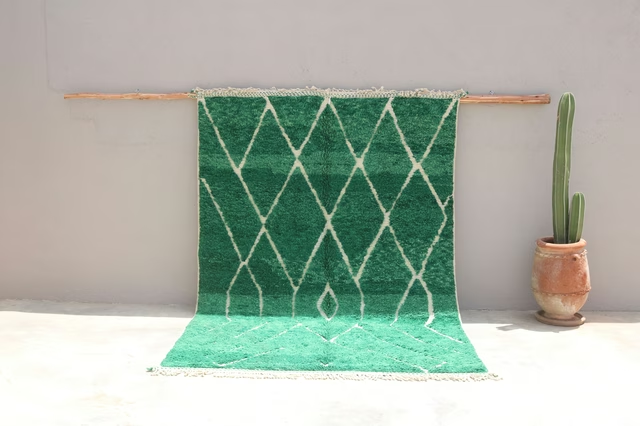
The rugs shown on this page come from our whole collection of 275 hand-knotted pieces. Twenty-three are small, between about 3 ft 1 in and 3 ft 10 in wide and 4 ft 6 in to 5 ft 5 in long, and twenty-one of those are multicoloured. Thirty-seven are mid-sized, up to about 6 ft by 9 ft 4 in. The largest group, 128 rugs, measures around 6 ft 7 in by 9 ft 10 in. A round rug can be made to order in our bespoke studio. Each rug is one of a kind, with its exact measurements on its own page. Delivery is free worldwide, duties and taxes included.
What you can verify about us
- Origin
- Made in MoroccoHand-knotted Berber rugs from the Atlas regions. Every rug is one of a kind.
- Construction
- Hand-knotted woolVerified at every stage — never machine-tufted.
- Delivery
- Duties includedFree shipping; import duties and taxes are included in the price.
- Returns
- 14 daysIn condition received, full refund of the purchase price.
Frequently Asked
Questions
- What size rug for a nursery?
- A 4x6 or 5x8 in the open floor of a small nursery, or an 8x10 in a larger room if the crib and chair are to stand on it. Keep all crib legs either on the rug or off it.
- Is a wool rug a good choice for a nursery?
- It is warm, springy and slow to absorb spills. It cannot be machine-washed and it sheds at first, so it needs regular vacuuming.
- Should a crib sit on the rug?
- Either fully on or fully off. Half on makes the crib stand unevenly.
- How do I clean a nursery rug?
- Vacuum with suction only. Blot spills at once with cold water and a little wool detergent, and never soak the rug.
Sources & References
What this page rests on
- 1. American Academy of Pediatrics
- 2. Wool Carpets Allergy Study

The person behind the piece
“Before you buy, I’ll send you a video of the actual rug in natural light — not a stock photo. I answer the messages myself.”
I’m Youssef. I started ARINID because this market is full of middlemen and machine-made imitations sold as the real thing — and I grew up close enough to the looms to know the difference.
Every piece we list is one of a kind, hand-knotted in Morocco. If you want to talk through sizing for your room, I’m on the other end of the message. A rug at this level is a thirty-year decision. You should be able to look the person selling it to you in the eye.
Youssef
Founder, ARINID
The next step
See every rug we currently offer
Each piece is hand-knotted in Morocco and delivered to your door, with shipping, duties and taxes included.