How to Authenticate a Moroccan Rug: Six Checks in Your Hands
Last updated
To authenticate a Moroccan rug you need the rug in front of you, ten minutes and no equipment. The question has two parts that are often confused. Is the rug hand-knotted in wool? And was it made in Morocco? The first can be settled with near certainty by looking and feeling. The second can only be made more or less likely, because a hand-knotted copy made elsewhere can pass every physical test. This page gives six checks, in the order to do them, says what each one proves, and is honest about where physical evidence ends.
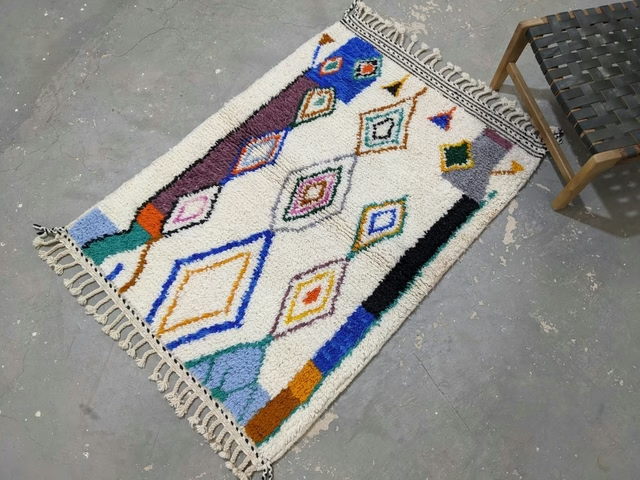
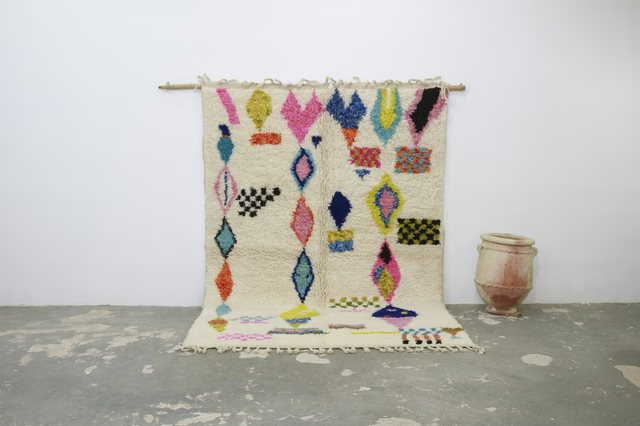
Checks one and two: the back and the fringe
Turn the rug over. On a hand-knotted rug you see the design again, slightly less sharp, made of small bumps in rows that are not perfectly straight. Each bump is a knot. If the back is covered by a cloth, the rug is tufted. If the back shows a perfectly regular grid with fine stitching running dead straight along it, the rug is machine-made.
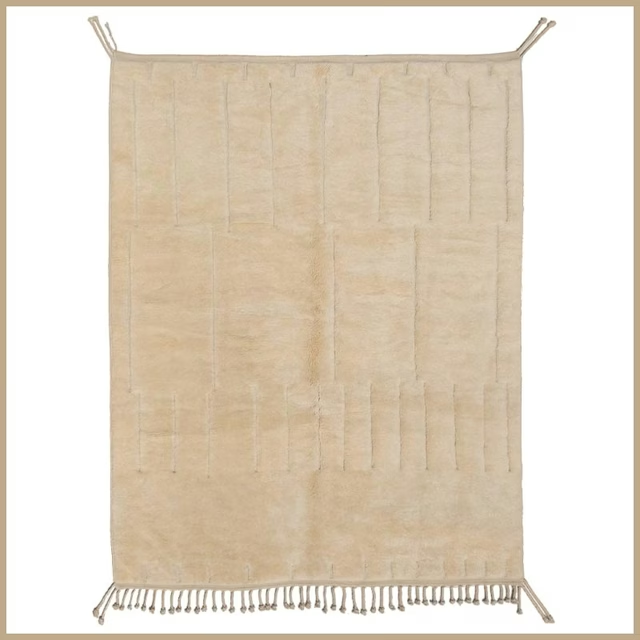
Then the fringe. On a knotted rug the fringe is the warp itself, coming out of the end of the rug. Part the pile at the end and you can follow a fringe thread into the body. A fringe that has been sewn or glued on as a strip is decoration. Many Moroccan rugs have a fringe at one end only, with a woven band at the other.
Checks three and four: the edges and the wool
Look along the sides. Hand-finished edges are wrapped in wool by hand and are slightly uneven in thickness. Machine-bound edges are perfectly uniform, with a tight, regular stitch. Then lay the rug flat and measure both ends: a difference of an inch or so between them is typical of a hand loom.
Feel the pile. Wool is matt and springy, slightly dry or waxy to the touch, and warm when you rest your palm on it. Polyester and polypropylene are slick, cooler and often shiny, and viscose is silky and limp. If you can tease a single loose fibre from the back, stretch it: wool is crimped and elastic.
Checks five and six: the drawing and the weight
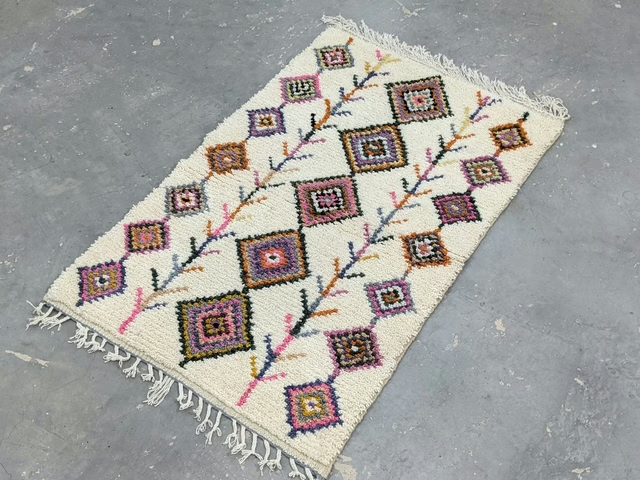
Compare the left half of the rug with the right, and the top with the bottom. In a rug knotted without a drawn plan they will not match. A diamond is wider on one side, a line stops early, a motif appears once. A design that is exactly symmetrical and repeats at regular intervals came from a template or a machine.
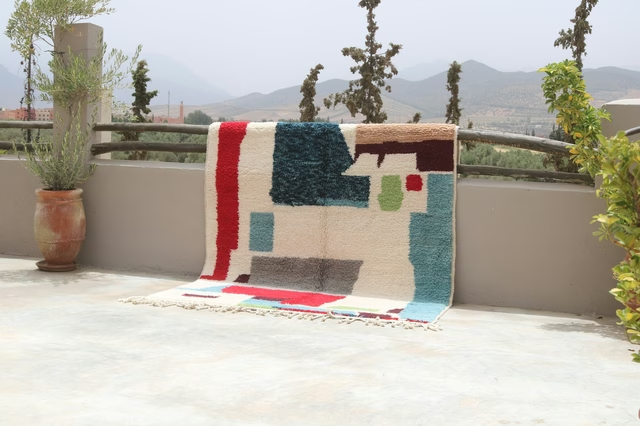
Lift a corner. A hand-knotted wool rug is heavy for its size and drapes, folding like a thick blanket. A tufted rug is stiff, because of its glued backing. A machine-made synthetic rug is light. None of these alone is proof, but six checks that all point the same way leave little doubt about how the rug was made.
What the checks cannot tell you
They establish construction and fibre. They do not establish origin. Rugs in Moroccan designs are hand-knotted in other countries too, and a well-made one will pass all six checks. Nor do they establish age: wear can be imitated, and a rug can be washed to look old.
Origin rests on the seller: who they are, where they buy, whether they describe each rug individually and will put the description in writing. A label sewn to the back, a story about a village and a handwritten certificate are not evidence in themselves. Specific, consistent answers are.
Our rugs
Every rug in our collection of 275 is knotted by hand, in wool, in Morocco, and each is described individually with its own measured size. When yours arrives, do the six checks. A rug that is what it claims to be has nothing to fear from them.
We describe rugs by type, such as Azilal, Beni Mrirt or Beni Ourain, and by what can be seen: colour, pattern and dimensions. We do not date them, and we do not attach a named weaver or a story to them. Each rug is one of a kind, with its exact measurements on its own page. Delivery is free worldwide, duties and taxes included.
What you can verify about us
- Origin
- Made in MoroccoHand-knotted Berber rugs from the Atlas regions. Every rug is one of a kind.
- Construction
- Hand-knotted woolVerified at every stage — never machine-tufted.
- Delivery
- Duties includedFree shipping; import duties and taxes are included in the price.
- Returns
- 14 daysIn condition received, full refund of the purchase price.
Frequently Asked
Questions
- How can I tell if a Moroccan rug is real?
- Check the back for knots, the fringe for continuity with the warp, the edges, the wool and the irregularity of the design.
- Can a rug pass these checks and not be Moroccan?
- Yes. They prove hand-knotting and wool, not the country. Origin depends on the seller's word and records.
- Should I do a burn test?
- It is not necessary. Feel, appearance and the structure of the back tell you enough without damaging the rug.
- Do authentic Moroccan rugs have a label?
- Some do and many do not. A label is not proof either way.
Sources & References
What this page rests on
- 1. Textile Authentication Laboratory
- 2. Major Auction House Authentication

The person behind the piece
“Before you buy, I’ll send you a video of the actual rug in natural light — not a stock photo. I answer the messages myself.”
I’m Youssef. I started ARINID because this market is full of middlemen and machine-made imitations sold as the real thing — and I grew up close enough to the looms to know the difference.
Every piece we list is one of a kind, hand-knotted in Morocco. If you want to talk through sizing for your room, I’m on the other end of the message. A rug at this level is a thirty-year decision. You should be able to look the person selling it to you in the eye.
Youssef
Founder, ARINID
The next step
See every rug we currently offer
Each piece is hand-knotted in Morocco and delivered to your door, with shipping, duties and taxes included.