Moroccan Rug: What It Is, the Main Types and How to Choose One
Last updated
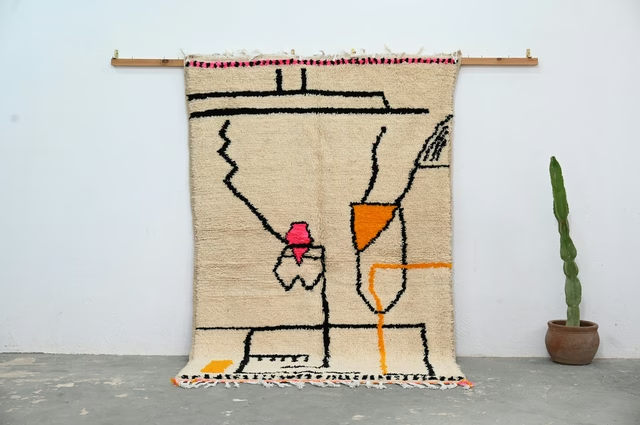
A Moroccan rug is a wool rug knotted by hand in Morocco, most often in the Atlas Mountains and the plains below them, by weavers who work from memory and not from a drawn pattern. That one fact explains most of what people like about them: the uneven diamonds, the lines that wander, the sizes that are never quite standard. The name covers several distinct kinds of rug, from ivory pieces with a few dark lines to rugs crowded with colour. This guide explains the main types, how they differ, and how to choose one for a room.
What makes a rug a Moroccan rug
Three things. The material is sheep's wool. The technique is hand-knotting on an upright loom: each tuft is tied around the warp threads, one at a time, and cut. And the design is not copied from a drawing pinned to the loom, as it is in many workshop carpets elsewhere. The weaver decides as she goes.
The result is a rug with a looser, freer character than a Persian or Turkish city carpet. The knots are larger and the drawing is bolder. Much of what is sold as a 'Moroccan rug' in large stores is a machine-made copy of this look in synthetic fibre. Those rugs are Moroccan in style only.
The main types of Moroccan rug
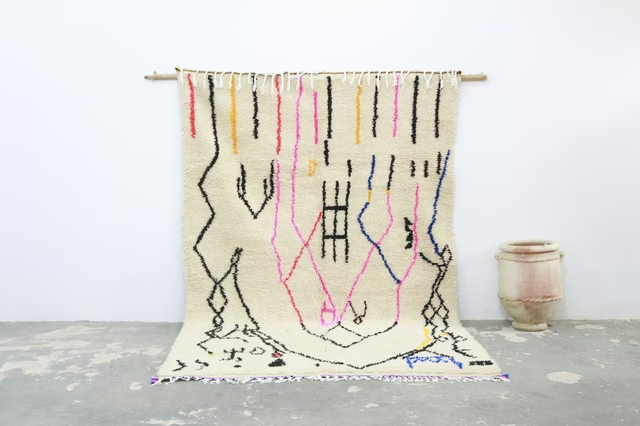
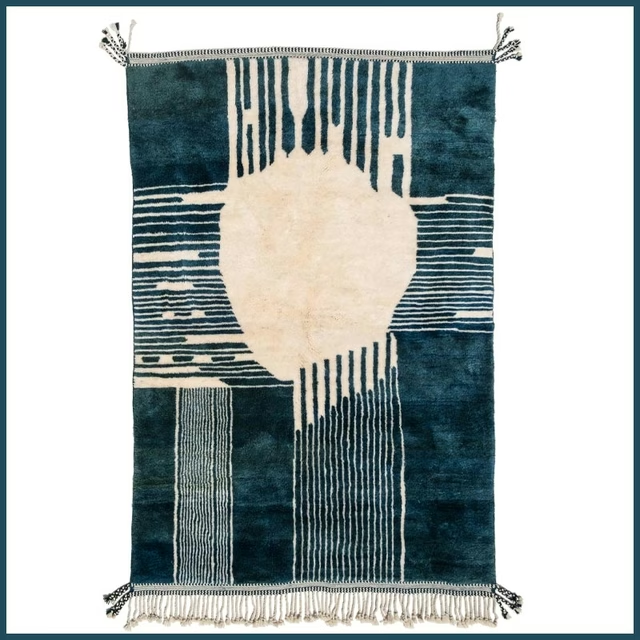
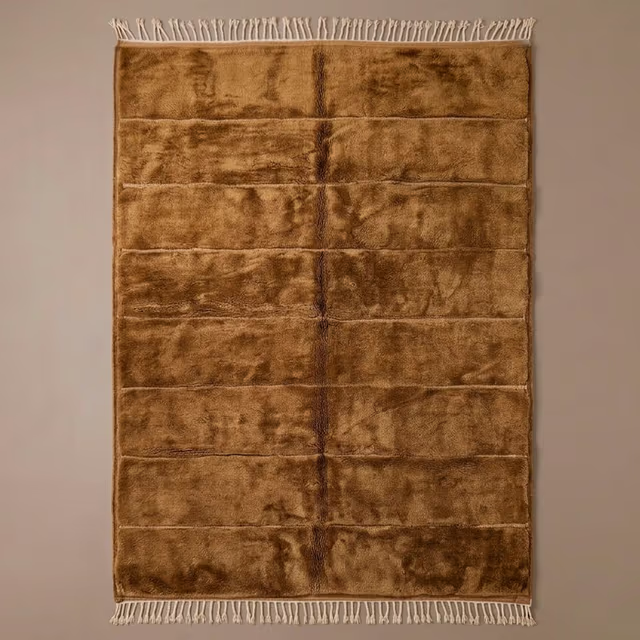
Rugs are named after the tribe or the town they come from. Beni Ourain rugs come from the Middle Atlas and are among the best known abroad: ivory wool, dark lines, diamonds. Beni Mrirt rugs come from the same mountains and are denser and heavier, often in a single colour or with very simple line drawing.
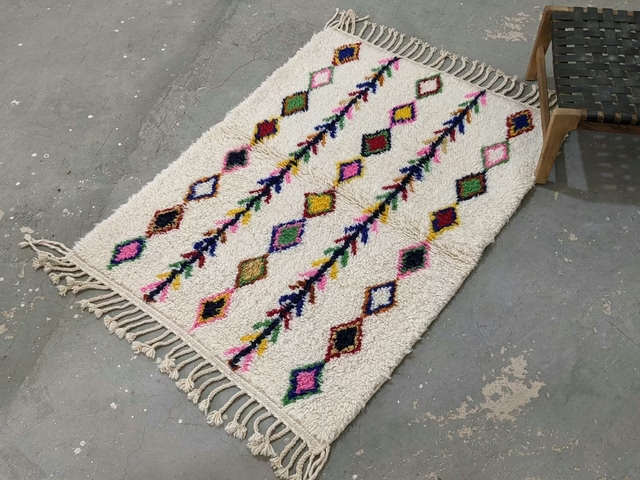
Azilal rugs come from the High Atlas. They are lighter, with coloured signs and diamonds. Beni Mguild rugs are known for deep colour, and Boujaad rugs, from the plains, for pinks, oranges and reds. Each name describes a tradition, not a factory standard, and two rugs of the same type can look quite different.
Patterns, and what can honestly be said about them
The vocabulary is small: diamonds, zigzags, chevrons, crosses, lines and combs, now and then a figure. In much that is written on the subject each sign is given a meaning, such as protection or fertility. We do not repeat those lists as fact. What a sign meant depended on the weaver and her village, and most of it was never written down.
What you can read from a rug is its hand. Lines that change direction, a border on one side only, a motif that appears once and never again: these are decisions made at the loom. If a rug sold as Moroccan is perfectly symmetrical and identical to the one beside it, it was made by a machine or from a template.
How to choose a Moroccan rug for a room
Start with size, because it is the one thing you cannot adjust later. In a living room the front legs of the sofa and chairs should stand on the rug. For most rooms that means about 8x10, and smaller rooms take 5x8 or 6x9. Hand-knotted rugs do not come in exact standard sizes, so read the measured dimensions and compare them with your floor.
Then decide how much the rug should say. An ivory rug with sparse lines is a background that suits almost any furniture. A multicoloured rug is the main event and wants plainer surroundings. Dense rugs suit dining rooms and busy areas, and a deeper pile belongs where you sit or walk barefoot.
The Moroccan rugs in our collection
We hold 275 rugs, every one hand-knotted and different. One hundred and twenty are Azilal and 119 are Beni Mrirt, with twenty-two Beni Ourain, eleven Beni Mguild, two Boujaad and one vintage piece. Seventy-eight are multicoloured, seventy-one have an ivory or cream ground and thirty-seven are sand or taupe. The rest include camel, terracotta, gold, teal and charcoal.
By size, 128 measure around 6 ft 7 in by 9 ft 10 in and fifty-six are larger. There are thirty-seven mid-sized rugs, thirty-one runners and twenty-three small rugs. If none fits, our bespoke studio makes a rug to your measurements. Each rug is one of a kind, with its exact measurements on its own page. Delivery is free worldwide, duties and taxes included.
What you can verify about us
- Origin
- Made in MoroccoHand-knotted Berber rugs from the Atlas regions. Every rug is one of a kind.
- Construction
- Hand-knotted woolVerified at every stage — never machine-tufted.
- Delivery
- Duties includedFree shipping; import duties and taxes are included in the price.
- Returns
- 14 daysIn condition received, full refund of the purchase price.
Frequently Asked
Questions
- What is a Moroccan rug?
- A wool rug knotted by hand in Morocco, usually without a drawn plan, which is why each one is different.
- What is the difference between a Moroccan rug and a Berber rug?
- In everyday use they mean the same thing. Berber, or Amazigh, refers to the people who weave most Moroccan rugs.
- Are Moroccan rugs good quality?
- A hand-knotted wool rug is durable and can be repaired. Machine-made rugs in the Moroccan style, in synthetic fibre, are a different product.
- What size Moroccan rug do I need?
- About 8x10 for most living rooms, with the front legs of the seating on the rug. Check the measured size of each piece.
Sources & References
What this page rests on
- 1. Bruno Barbatti — textile historian — Tapis du Maroc — Le langage des symboles (1996) — Scheidegger & SpiessThe reference work on the symbolic vocabulary of Berber rug motifs.
- 2. Prosper Ricard — French Protectorate ethnographer — Corpus des tapis marocains (1923) — Service des Arts Indigènes (1923–1934)The first systematic Western catalogue of Moroccan rug types. Still the working taxonomy.
- 3. Cynthia Becker — Boston University — Amazigh Arts in Morocco: Women Shaping Berber Identity (2006) — University of Texas PressAnthropological study of Atlas weaving as Amazigh women's craft tradition.
- 4. Leigh Minturn — The Economic Importance and Technological Complexity of Hand-Spinning and Hand-Weaving (1996)Cross-cultural anthropological study of hand-spinning and hand-weaving labour.
- 5. Metropolitan Museum of Art (New York) — Hanging (Arid), ca. 1800 — linen and silk plain weaveMet collection holding of c.1800 Arid weaving — precursor textile tradition to documented Berber rugs.
- 6. Musée du Quai Branly — Jacques Chirac (Paris) — Berber and North African textile collectionMajor French museum holding of Berber and Maghreb weaving traditions.
- 7. Victoria & Albert Museum (London) — Moroccan textile collection — includes BoucherouiteV&A holds documented Moroccan textiles including Boucherouite examples.
- 8. Wikipedia — Moroccan rugs

The person behind the piece
“Before you buy, I’ll send you a video of the actual rug in natural light — not a stock photo. I answer the messages myself.”
I’m Youssef. I started ARINID because this market is full of middlemen and machine-made imitations sold as the real thing — and I grew up close enough to the looms to know the difference.
Every piece we list is one of a kind, hand-knotted in Morocco. If you want to talk through sizing for your room, I’m on the other end of the message. A rug at this level is a thirty-year decision. You should be able to look the person selling it to you in the eye.
Youssef
Founder, ARINID
The next step
See every rug we currently offer
Each piece is hand-knotted in Morocco and delivered to your door, with shipping, duties and taxes included.