Natural Dye Rugs: What the Term Means and How Far to Trust It
Last updated
Natural dye rugs are rugs whose wool was coloured with dyes taken from plants, insects or minerals, as all rugs were until the second half of the nineteenth century. The phrase is now one of the most used and least reliable in the trade. Synthetic dyes have been in general use for well over a century, and a seller rarely knows for certain what is in a given rug. This page explains what natural dyeing involves, how the two kinds of dye differ in a finished rug, why natural is not automatically better, and why we do not describe the dyes of our own rugs.
What natural dyeing involves
The classic sources are few. Madder root gives reds, from brick to deep crimson. Indigo gives blue. Weld, pomegranate rind and other plants give yellows. Walnut husks and oak galls give browns and blacks. Greens, oranges and purples are made by dyeing one colour over another. Cochineal, an insect, gives a cooler red.
Most of these dyes will not hold on wool unaided. The yarn is first treated with a mordant, a mineral salt such as alum, which binds the dye to the fibre. Indigo is the exception and needs a fermentation vat. It is slow, skilled work, and results vary with the water, the season and the plant.
Synthetic dyes are not the villain
The first synthetic dyes reached the weaving regions in the later nineteenth century, and the early ones were poor: they faded quickly or ran. That is where the bad reputation comes from. Modern synthetic dyes for wool are a different matter. Properly applied, they are stable in light and in washing, and consistent.
The great majority of rugs made anywhere today, hand-knotted ones included, are dyed with synthetic dyes, in whole or in part. A good synthetic dye, well applied, will outlast a natural dye badly applied. What matters to the owner is whether the colour is stable, and that depends on the dyer's care more than on the source of the dye.
How the two look in a rug
Naturally dyed wool often shows slight unevenness within one colour, because batches differ and the dye takes differently along a hand-spun yarn. The colours tend to sit together easily, since they come from a limited range of sources. With age they mellow gently.
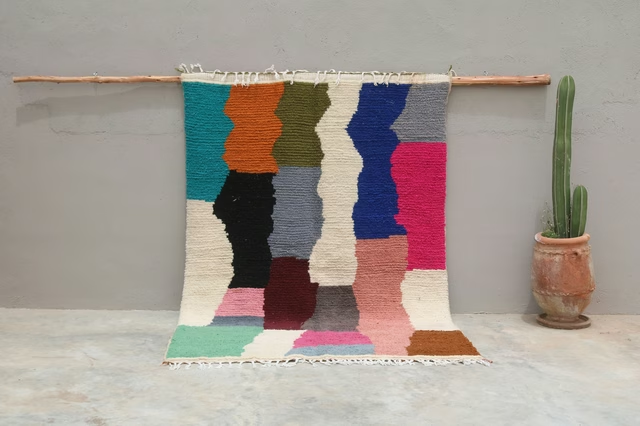
Synthetic dyes can do all of that too, when a dyer chooses. They can also produce what natural dyes cannot: very bright pinks, oranges and purples, and perfectly uniform fields. A vivid, saturated fuchsia or turquoise is a reliable sign of a synthetic dye. A soft, uneven colour is not proof of a natural one.
Can you tell natural dye rugs apart? Tests and their limits
Not with certainty, at home. The tests found online, such as rubbing with a wet cloth, looking at the root of the pile or studying how the colour has faded, show whether a dye is stable and how the rug has aged. They do not identify what the dye is made of. Certain identification needs laboratory analysis of a fibre sample.
For that reason, treat any confident statement that a rug is all natural dyes with caution, unless the seller can say who dyed the wool and with what. The test worth doing is the practical one: press a damp white cloth on each colour for a minute. If nothing transfers, the dye is stable, and that is what you need to know before cleaning.
Why we make no dye claims
We do not describe the dyes in our rugs as natural, vegetable or plant-based. We cannot verify it piece by piece, and we would rather make no claim than one we cannot support. We describe each rug by the colour you can see.
Our collection is 275 hand-knotted wool rugs from Morocco. Seventy-one have an ivory or cream ground, thirty-seven are sand or taupe and seventy-eight are multicoloured. Each rug is one of a kind, with its exact measurements on its own page. Delivery is free worldwide, duties and taxes included.
What you can verify about us
- Origin
- Made in MoroccoHand-knotted Berber rugs from the Atlas regions. Every rug is one of a kind.
- Construction
- Hand-knotted woolVerified at every stage — never machine-tufted.
- Delivery
- Duties includedFree shipping; import duties and taxes are included in the price.
- Returns
- 14 daysIn condition received, full refund of the purchase price.
Frequently Asked
Questions
- What are natural dye rugs?
- Rugs whose wool was coloured with dyes from plants, insects or minerals, such as madder, indigo and walnut.
- Are natural dyes better than synthetic dyes?
- Not necessarily. A well-applied modern synthetic dye is stable and long-lasting. The dyer's care matters more than the source.
- How can I tell if a rug has natural dyes?
- You cannot be certain without laboratory analysis. Very bright, uniform colours point to synthetic dyes.
- Are your rugs naturally dyed?
- We make no claim about dyes, because we cannot verify it for each piece.
Sources & References
What this page rests on
- 1. Hiba Swadi, Nagham Swadi & Meena M. Abdul-Hussain — Using Walnut Peel as a Natural Dye with Natural Wool FibersResearch on walnut-hull dyeing of wool — the dominant dark brown source in Atlas weaving.
- 2. Bruno Barbatti — textile historian — Tapis du Maroc — Le langage des symboles (1996) — Scheidegger & SpiessThe reference work on the symbolic vocabulary of Berber rug motifs.
- 3. Prosper Ricard — French Protectorate ethnographer — Corpus des tapis marocains (1923) — Service des Arts Indigènes (1923–1934)The first systematic Western catalogue of Moroccan rug types. Still the working taxonomy.
- 4. Wikipedia — Moroccan rugs

The person behind the piece
“Before you buy, I’ll send you a video of the actual rug in natural light — not a stock photo. I answer the messages myself.”
I’m Youssef. I started ARINID because this market is full of middlemen and machine-made imitations sold as the real thing — and I grew up close enough to the looms to know the difference.
Every piece we list is one of a kind, hand-knotted in Morocco. If you want to talk through sizing for your room, I’m on the other end of the message. A rug at this level is a thirty-year decision. You should be able to look the person selling it to you in the eye.
Youssef
Founder, ARINID
The next step
See every rug we currently offer
Each piece is hand-knotted in Morocco and delivered to your door, with shipping, duties and taxes included.