Moroccan Rug History: What Is Known and What Is Often Repeated
Last updated
Moroccan rug history is told with great confidence on many websites, complete with dates reaching back thousands of years. The truth is more modest and more interesting. Wool rugs made for daily use in a damp, cold mountain climate do not survive for centuries, and the people who wove them left few written records. What we have is a small number of old pieces, the accounts of travellers and ethnographers, and living practice. This page separates what can be said with reasonable confidence from what is tradition and what is sales talk, and it leaves out claims we cannot stand behind.
From the Atelier
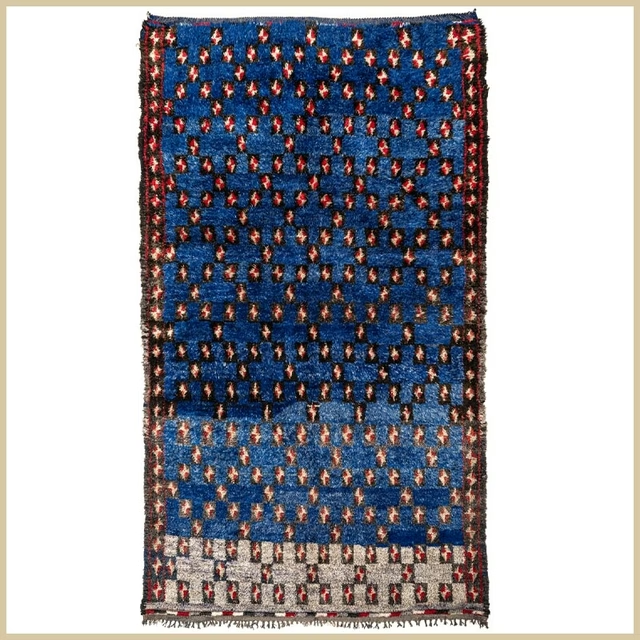
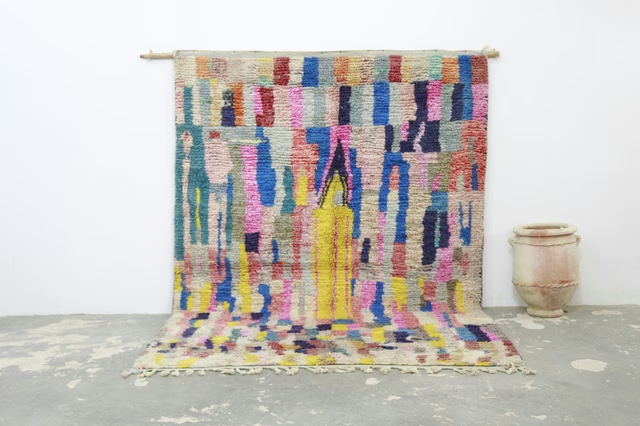
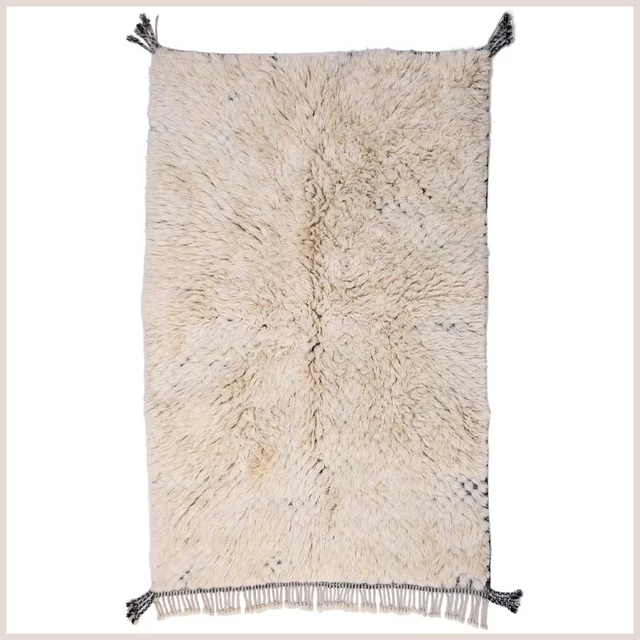
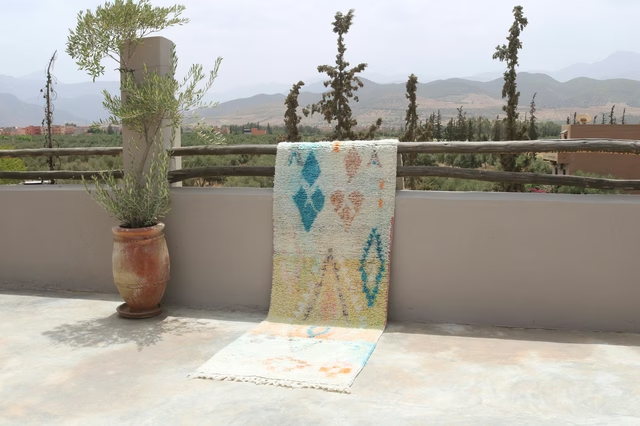
Currently in our collection
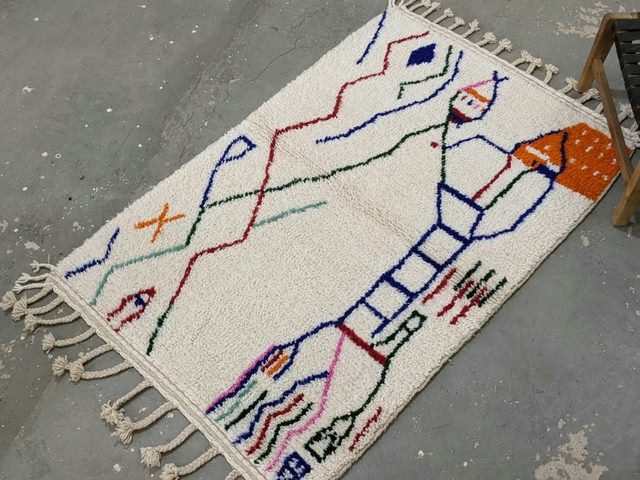
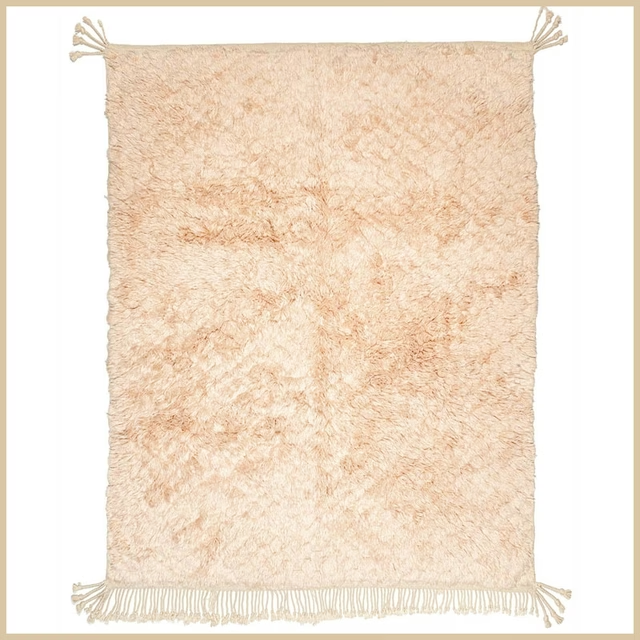
What can be said with confidence
Weaving in wool is very old in North Africa and was, until recently, part of ordinary household work among rural Amazigh families. Women spun and wove what the home needed: blankets, cloaks, tent cloth, covers and rugs. Rugs were made to be used, not sold.
It is also clear that Morocco developed two traditions side by side: the rural rugs of the tribes, and the urban carpets of towns such as Rabat, which follow planned designs with medallions and borders. And it is clear that very few rural rugs older than the nineteenth century are known to exist.
Why old rugs are so rare
A rug used as bedding or flooring in a mountain house wears out within a generation or two. It is patched, cut down, and finally replaced. Nobody kept it as an heirloom in a chest, as court carpets were kept elsewhere.
Collectors and museums only began to take serious notice of rural Moroccan rugs in the twentieth century. By then the oldest pieces had gone. This is why dates given for the origin of particular designs are estimates at best, and why claims of unbroken tradition over thousands of years cannot be checked.
The twentieth century
The modern story is better documented. During the first half of the twentieth century, rural rugs began to be collected, studied and sold beyond their home regions, and weaving for the market grew alongside weaving for the home.
It is often said that modernist architects and designers in Europe and America took to these rugs, especially the ivory ones, because they suited plain modern interiors. We repeat that as the usual account and have not verified the individual stories that go with it. What is not in doubt is that demand from abroad has shaped what is woven ever since.
Moroccan rug history and today's rugs
Most Moroccan rugs sold today were made recently, for sale, in designs that continue or adapt the older ones. Sizes have grown to suit foreign rooms. Some types, such as Beni Mrirt, are modern developments within an old craft.
None of this makes a rug less genuine. A rug knotted by hand in wool in Morocco, without a drawn plan, belongs to the tradition whenever it was made. What deserves suspicion is a new rug sold with an invented past: a precise age, a tribal elder, a meaning for every motif.
What we claim
We sell 275 hand-knotted wool rugs from Morocco and describe them by type, colour, pattern and measured size. Almost all are recently made in long-established designs, and one is listed as vintage. We do not date our rugs and do not sell any as antique.
We would rather give you less history and have all of it be true. The rugs shown on this page come from the whole collection. Each rug is one of a kind, with its exact measurements on its own page. Delivery is free worldwide, duties and taxes included.
What you can verify about us
- Origin
- Made in MoroccoHand-knotted Berber rugs from the Atlas regions. Every rug is one of a kind.
- Construction
- Hand-knotted woolVerified at every stage — never machine-tufted.
- Delivery
- Duties includedFree shipping; import duties and taxes are included in the price.
- Returns
- 14 daysIn condition received, full refund of the purchase price.
Frequently Asked
Questions
- How old is the Moroccan rug tradition?
- Wool weaving in North Africa is very old, but few rural rugs older than the nineteenth century survive, so precise dates cannot be given.
- Why are there so few antique Moroccan rugs?
- They were made for daily use and wore out. They were not stored as heirlooms.
- Are Moroccan rugs sold today traditional?
- Most are recently made in long-established designs, sometimes adapted in size and colour for modern homes.
- Do you date your rugs?
- No. We describe them by what can be verified: type, colour, pattern and size.
Sources & References
What this page rests on
- 1. Prosper Ricard — French Protectorate ethnographer — Corpus des tapis marocains (1923) — Service des Arts Indigènes (1923–1934)The first systematic Western catalogue of Moroccan rug types. Still the working taxonomy.
- 2. Bruno Barbatti — textile historian — Tapis du Maroc — Le langage des symboles (1996) — Scheidegger & SpiessThe reference work on the symbolic vocabulary of Berber rug motifs.
- 3. Cynthia Becker — Boston University — Amazigh Arts in Morocco: Women Shaping Berber Identity (2006) — University of Texas PressAnthropological study of Atlas weaving as Amazigh women's craft tradition.
- 4. Orit Ouaknine-Yekutieli — The Glaoua Tribe on River Seine (2024)Academic study of the Glaoua dynasty and its representation in French colonial discourse.
- 5. Metropolitan Museum of Art (New York) — Hanging (Arid), ca. 1800 — linen and silk plain weaveMet collection holding of c.1800 Arid weaving — precursor textile tradition to documented Berber rugs.
- 6. Musée du Quai Branly — Jacques Chirac (Paris) — Berber and North African textile collectionMajor French museum holding of Berber and Maghreb weaving traditions.

The person behind the piece
“Before you buy, I’ll send you a video of the actual rug in natural light — not a stock photo. I answer the messages myself.”
I’m Youssef. I started ARINID because this market is full of middlemen and machine-made imitations sold as the real thing — and I grew up close enough to the looms to know the difference.
Every piece we list is one of a kind, hand-knotted in Morocco. If you want to talk through sizing for your room, I’m on the other end of the message. A rug at this level is a thirty-year decision. You should be able to look the person selling it to you in the eye.
Youssef
Founder, ARINID
The next step
See every rug we currently offer
Each piece is hand-knotted in Morocco and delivered to your door, with shipping, duties and taxes included.