Turkish Rug or Moroccan Rug: Two Traditions Compared
Last updated
A Turkish rug and a Moroccan rug are often shown side by side in the same shops, and they come from opposite ends of the Mediterranean. Turkey has one of the oldest and most varied rug traditions in the world, from court carpets in silk to village rugs and flat-woven kilims. Morocco's tradition is rural and domestic, made for the home and not for the palace. Both are knotted by hand in wool, and beyond that they look, feel and behave differently. This page compares them fairly, so that you can tell which suits your room. We sell Moroccan rugs, and say so.
From the Atelier
Currently in our collection
What a Turkish rug is
Turkish, or Anatolian, rugs range widely. Oushak carpets from the west are large, soft in colour and loosely drawn, with big floral forms, and decorators value them for their faded apricots, golds and blues. Hereke rugs are very fine workshop pieces, some of them in silk. Village rugs from places such as Bergama, Konya and Milas are smaller, bolder and geometric.
Turkey is also the home of the kilim, the flat-woven rug without pile, and of a large trade in vintage rugs: old village pieces, sometimes sheared low, washed pale or dyed over in a single strong colour. When a shop offers a vintage Turkish rug, it is usually one of these.
Design
Most Turkish pile rugs have an organised layout: a field, one or more medallions or a niche, and a frame of borders. The motifs are stylised flowers, stars and hooked shapes, and they repeat in order. Colour is rich and varied, with reds, blues and golds in a single piece.
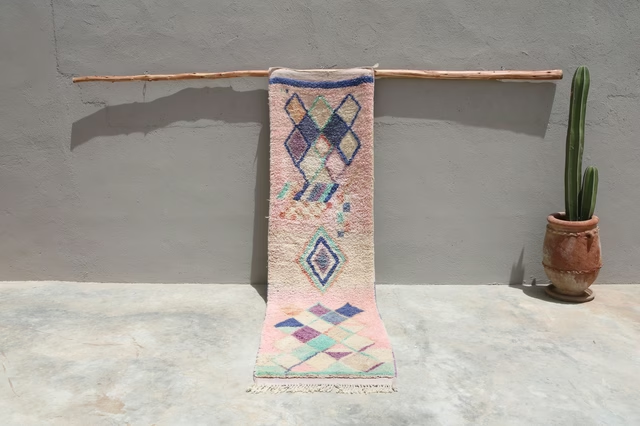
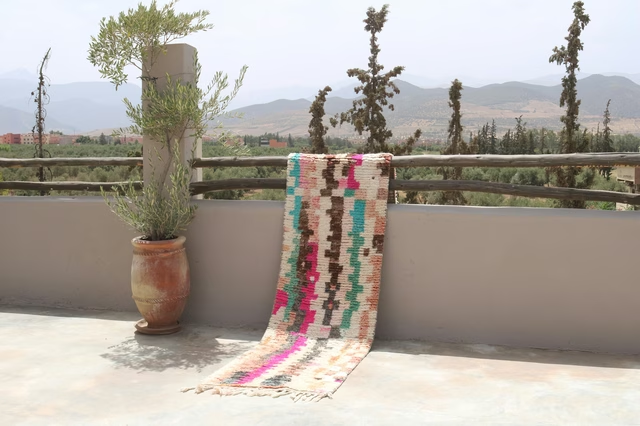
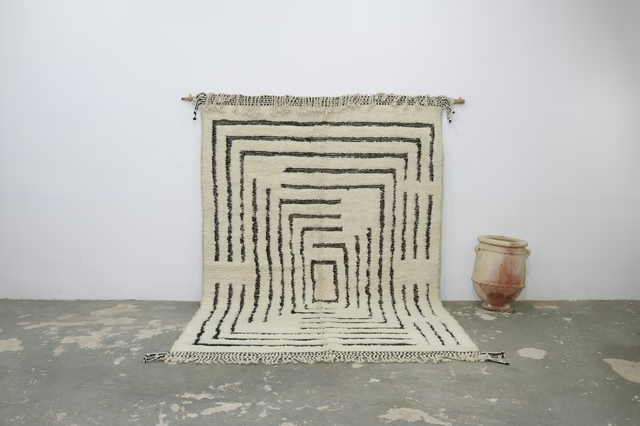
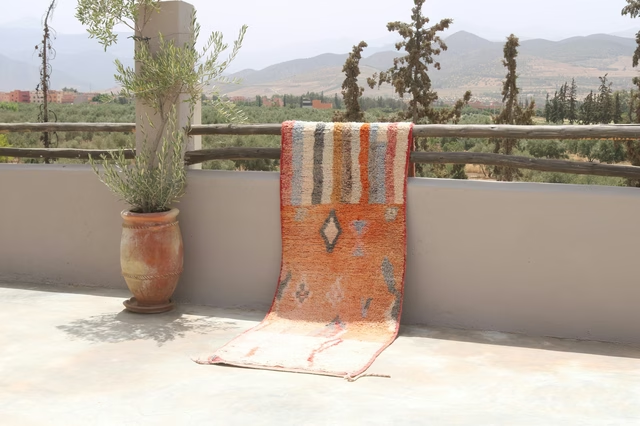
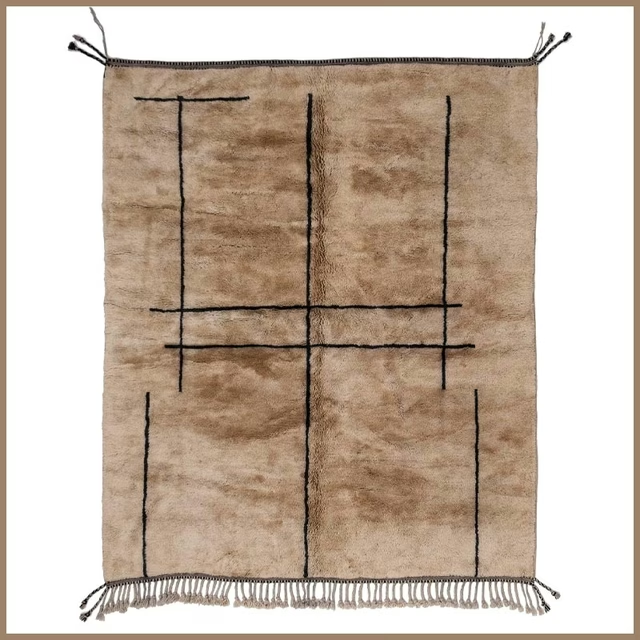
A Moroccan rug usually has no border and no centre. The design runs to the edge and stops. It is made of diamonds, lines and scattered signs, often in two colours only, or in many colours with no fixed scheme. Where a Turkish rug is composed, a Moroccan rug is improvised.
Structure and feel
Many rugs in both traditions are tied with the same symmetrical knot, which is often simply called the Turkish knot. The difference is in density and pile. Turkish village and workshop rugs are generally knotted more finely and sheared shorter, which gives a firm, flat-lying surface and a clear drawing.
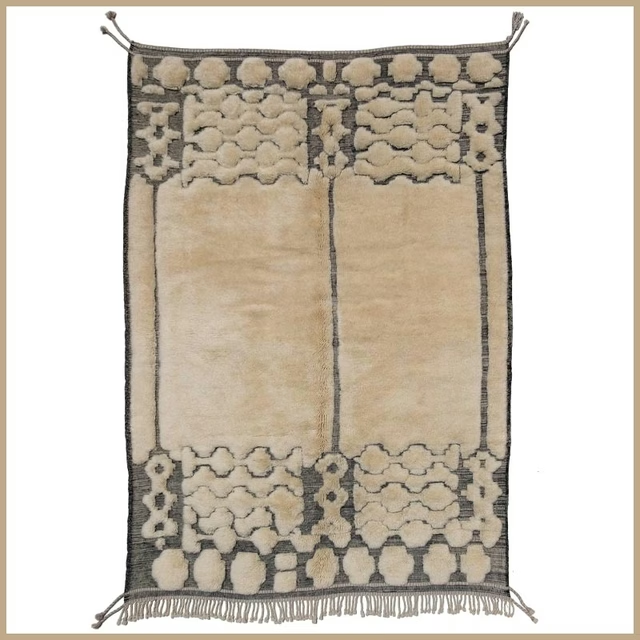
Moroccan rugs have larger knots and, in types such as Beni Ourain, a thicker, softer pile. They are deeper underfoot and less sharply drawn. Anatolia does have a long-piled relative, the tulu, a shaggy, simply patterned rug that feels very close to a Moroccan one.
A Turkish rug and a Moroccan rug in the home
A Turkish rug with a low pile is a good choice under a dining table, in a hall or in a study: chairs move on it, it vacuums easily and its pattern hides wear. An Oushak in soft colours works in formal and traditional rooms, and in the relaxed, layered interiors that mix old and new.
A Moroccan rug is at its best where comfort leads: living rooms, bedrooms, anywhere people sit on the floor. Its plain, graphic design suits modern furniture. The two mix well in one house, and even in one room if you layer a small patterned Turkish piece over a large plain Moroccan one.
Which to choose, and what we hold
If you want rich colour, borders and a classic look, or a tough low rug for a dining room, look at Turkish rugs. If you want softness, simplicity and a design that looks drawn by hand, look at Moroccan ones. Check any rug in the same way: turn it over, look for the pattern on the back, and ask for the fibre and the measured size.
We do not sell Turkish rugs. Our collection is 275 hand-knotted Moroccan wool rugs: 120 Azilal, 119 Beni Mrirt, twenty-two Beni Ourain, eleven Beni Mguild, two Boujaad and one vintage piece. Each rug is one of a kind, with its exact measurements on its own page. Delivery is free worldwide, duties and taxes included.
What you can verify about us
- Origin
- Made in MoroccoHand-knotted Berber rugs from the Atlas regions. Every rug is one of a kind.
- Construction
- Hand-knotted woolVerified at every stage — never machine-tufted.
- Delivery
- Duties includedFree shipping; import duties and taxes are included in the price.
- Returns
- 14 daysIn condition received, full refund of the purchase price.
Frequently Asked
Questions
- What is the difference between a Turkish rug and a Moroccan rug?
- Turkish rugs are usually bordered, finely knotted and rich in colour. Moroccan rugs are borderless, more coarsely knotted, softer and simpler in design.
- Are Turkish rugs good quality?
- Hand-knotted Turkish wool rugs are durable and long-lived. As with any rug, check the back, the fibre and the construction.
- What is an Oushak rug?
- A Turkish carpet from the Uşak region, known for large-scale floral designs and soft, faded colours.
- Do you sell Turkish rugs?
- No. We sell hand-knotted Moroccan rugs only.
Sources & References
What this page rests on
- 1. Comparative Textile Traditions Study
- 2. Anatolian Rug Weaving Atlas

The person behind the piece
“Before you buy, I’ll send you a video of the actual rug in natural light — not a stock photo. I answer the messages myself.”
I’m Youssef. I started ARINID because this market is full of middlemen and machine-made imitations sold as the real thing — and I grew up close enough to the looms to know the difference.
Every piece we list is one of a kind, hand-knotted in Morocco. If you want to talk through sizing for your room, I’m on the other end of the message. A rug at this level is a thirty-year decision. You should be able to look the person selling it to you in the eye.
Youssef
Founder, ARINID
The next step
See every rug we currently offer
Each piece is hand-knotted in Morocco and delivered to your door, with shipping, duties and taxes included.