Handmade vs Machine Made Rug: How to Tell and What Changes at Home
Last updated
Handmade vs machine made rug is not a question of snobbery. The two are different products that happen to look alike in a photograph. One is built by a person, knot by knot, over weeks, and can last a lifetime. The other is woven on a power loom in hours and is designed to be affordable and replaceable. Each has its place. Trouble starts only when one is sold as the other. This page shows how to tell if a rug is handmade in half a minute, then compares the two where it counts: how they wear, feel, clean and age, and when a machine made rug is the sensible choice.
From the Atelier
Currently in our collection
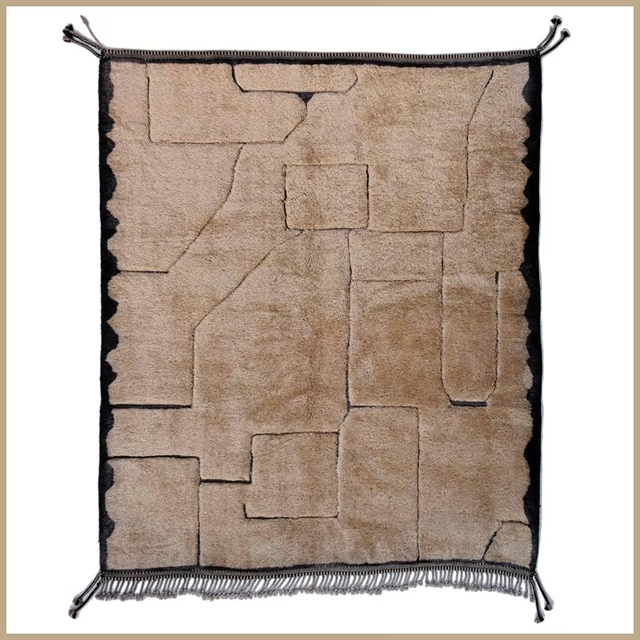
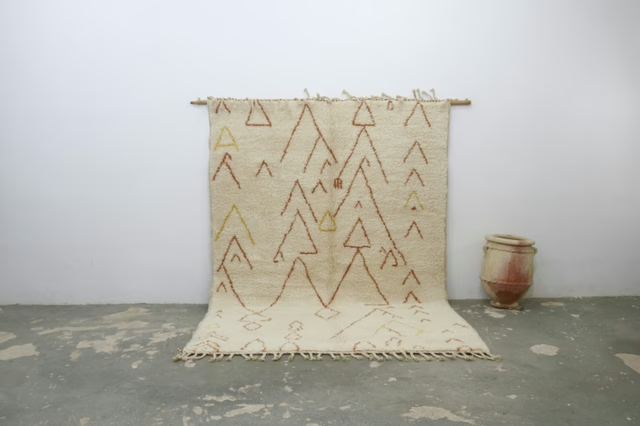
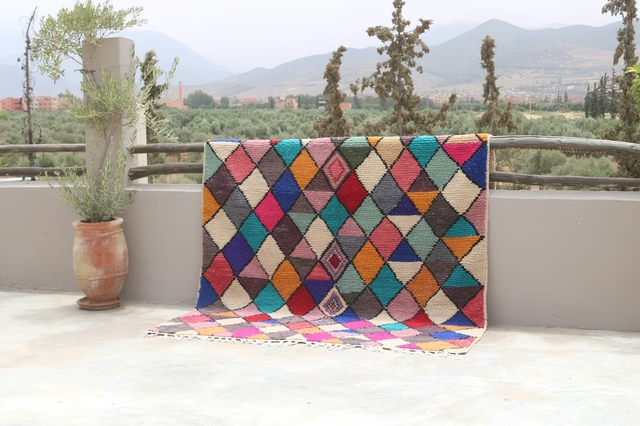
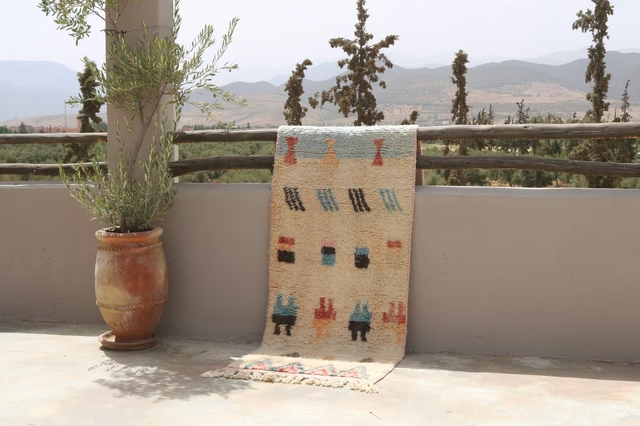
How to tell if a rug is handmade in thirty seconds
Turn it over. A machine made rug has a back that is perfectly regular, often with a stiff coating, and rows of fine stitching that run dead straight from end to end. A handmade knotted rug shows the pattern of the front in slightly uneven rows of knots. A cloth glued over the back means hand-tufted.
Look at the fringe and the edges. Machine made fringe is sewn on afterwards, and the edges are bound by a machine with a tight, identical stitch. On a hand-knotted rug the fringe grows out of the rug, and the sides are wrapped by hand. Then look at the design: perfect symmetry and exact repeats are the signature of a machine.
Wear and lifespan
A machine made synthetic rug looks its best on the day it is unrolled. The pile flattens along the routes people walk, the edges curl, and after some years it is replaced. Machine made wool rugs last longer, but share the weak point of a stiff backing that cracks with folding and age.
A hand-knotted wool rug wears slowly and evenly, because each tuft is tied in and the wool recovers. It can be washed, rebound at the edges, secured at the ends and rewoven where it is damaged. With ordinary care its life is measured in decades. It is the difference between a consumable and a piece of furniture.
Feel, look and sound
Handmade rugs are more supple. They drape and lie heavily on the floor, and the pile has depth and slight variation. Colour is rarely flat: batches of yarn differ a little, so a field of one colour has life in it. No two are identical.
Machine made rugs are uniform by design. Every one is the same as the next, the surface is even, and colour is consistent to the edge. That is an advantage when you need a pair, or the same rug in three sizes. Underfoot they are usually thinner and firmer, and synthetic ones can feel slightly slick and build up static.
Cleaning, repair and practicalities
Machine made synthetic rugs resist stains well, and some can be machine-washed or hosed down, which is a real advantage with small children, pets in training or a rented flat. They cannot be repaired in any meaningful way. When the backing or the pile goes, the rug is finished.
Handmade wool rugs need gentler care: suction only, blotting with cold water, a specialist wash every few years. In return almost anything can be put right. They are also heavier, and they come in the sizes at which they were woven and not from a menu. If you need exactly 8 by 10 feet tomorrow, a machine made rug is easier.
Which to buy, and what we hold
Buy machine made for short-term rooms, for places that need washing often, and when little is to be spent on the room. Buy handmade for rooms you intend to keep, where the rug will be looked at and lived on for years. Many homes sensibly have both.
We hold handmade rugs only: 275 hand-knotted wool rugs from Morocco. Turn yours over when it arrives and you will see the knots. Each rug is one of a kind, with its exact measurements on its own page. Delivery is free worldwide, duties and taxes included.
What you can verify about us
- Origin
- Made in MoroccoHand-knotted Berber rugs from the Atlas regions. Every rug is one of a kind.
- Construction
- Hand-knotted woolVerified at every stage — never machine-tufted.
- Delivery
- Duties includedFree shipping; import duties and taxes are included in the price.
- Returns
- 14 daysIn condition received, full refund of the purchase price.
Frequently Asked
Questions
- How can you tell if a rug is handmade?
- Look at the back. Slightly uneven rows of knots that repeat the front pattern mean hand-knotted. A perfectly regular back means machine made.
- Are handmade rugs better than machine made ones?
- They last far longer and can be repaired. Machine made rugs are easier to replace and sometimes washable.
- Is hand-tufted the same as handmade?
- It is made by hand with a tufting tool, but it has a glued backing and a much shorter life than a knotted rug.
- Why are handmade rugs never exactly symmetrical?
- They are made by a person without a machine's precision, so lines and sizes vary slightly.
Sources & References
What this page rests on
- 1. Wool Carpet Manufacturers Association
- 2. Atlas Cooperative Labour Standards

The person behind the piece
“Before you buy, I’ll send you a video of the actual rug in natural light — not a stock photo. I answer the messages myself.”
I’m Youssef. I started ARINID because this market is full of middlemen and machine-made imitations sold as the real thing — and I grew up close enough to the looms to know the difference.
Every piece we list is one of a kind, hand-knotted in Morocco. If you want to talk through sizing for your room, I’m on the other end of the message. A rug at this level is a thirty-year decision. You should be able to look the person selling it to you in the eye.
Youssef
Founder, ARINID
The next step
See every rug we currently offer
Each piece is hand-knotted in Morocco and delivered to your door, with shipping, duties and taxes included.