Persian Rug or Moroccan Rug: How They Differ and Which Suits You
Last updated
A Persian rug and a Moroccan rug are both hand-knotted in wool, and they could hardly be more different. One comes from a tradition of workshops, drawn designs and very fine knotting, and aims at perfection. The other comes from homes in the mountains, is knotted from memory and makes a virtue of irregularity. Neither is better. They do different things in a room and suit different temperaments. This page sets the two side by side: how they are made, how they look, how they wear, and how to decide between them. We sell Moroccan rugs, and we have tried to be fair to both.
From the Atelier
Currently in our collection
What a Persian rug is
A Persian rug is one knotted in Iran. The best known come from city workshops such as Tabriz, Isfahan, Kashan and Kerman, where weavers follow a design drawn knot for knot on squared paper. The classic layout is a central medallion on a field of scrolling flowers and vines, enclosed by several borders.
There is also a village and nomadic side to Persian weaving, with bolder, more geometric rugs such as Heriz, and the coarse, simple Gabbeh of the south-west, which is the Persian rug closest in spirit to a Moroccan one. The word therefore covers a wide range. What most people mean by it is the fine, floral, bordered city carpet in reds and blues.
How they are made
Both are tied knot by knot on a loom. The difference lies in fineness and planning. A good city Persian rug has anything from a hundred to several hundred knots to the square inch, usually on a cotton foundation, with a short, even pile that lets a curved line be drawn precisely. Symmetry is the aim, and the two halves of the rug mirror each other.
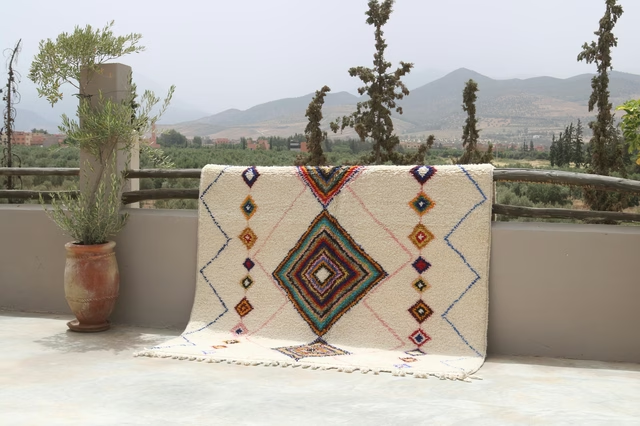
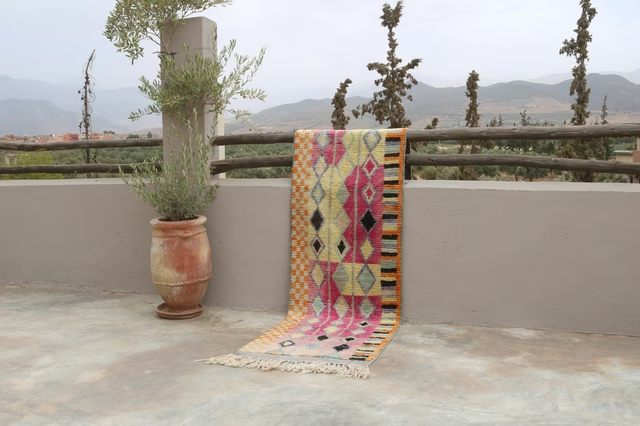
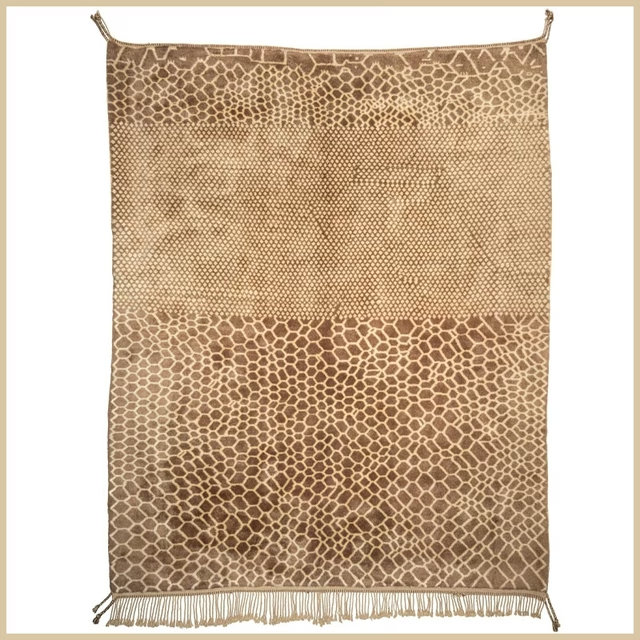
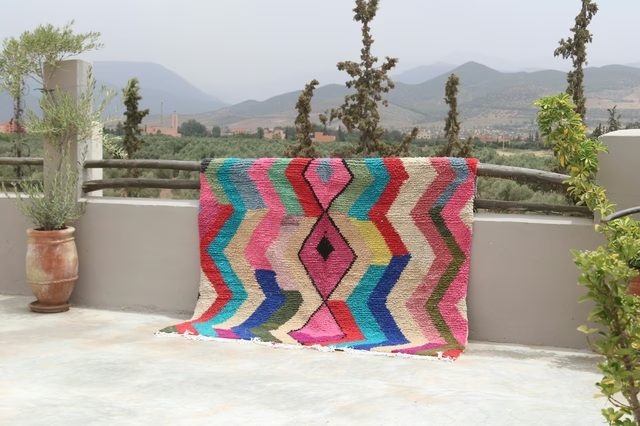
A Moroccan rug has far fewer and larger knots and no drawing to follow. Fine curves are impossible at that scale, so the design is made of straight lines: diamonds, bands, zigzags. The weaver composes as she goes, and the two halves of the rug rarely match.
How they look in a room
A Persian rug is detailed and formal. It rewards close looking, holds its own with antiques, panelling and dark wood, and brings pattern and several colours into a room at once. Its borders frame the furniture. In a spare modern room it becomes the single rich object.
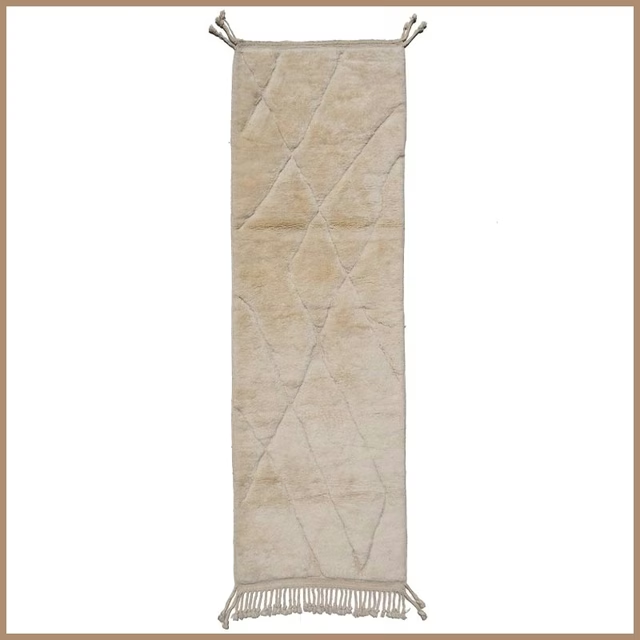
A Moroccan rug is graphic and relaxed. From across the room you take in the whole design at a glance. It sits easily with modern and Scandinavian furniture, bare walls and pale wood, and it feels informal: a rug to sit on. An ivory Moroccan rug brightens a room, where most Persian rugs, with their deep reds and blues, darken and enrich it.
Wear, care and living with each
A dense, short-piled Persian rug is very hard-wearing, easy to vacuum and well suited to dining rooms and halls. Chairs slide on it, and its busy pattern hides stains. Old ones in good condition are sought after, and the trade in them is long established.
A Moroccan rug with a deeper pile is softer and warmer underfoot, and better in sitting rooms and bedrooms than under a dining table. It sheds a little at first, and a pale one shows marks sooner. Both kinds are cared for in the same way: suction only, a half-turn twice a year, spills blotted with cold water, and a wash by a specialist when needed.
Which to choose, and what we hold
Choose a Persian rug if you love detail, colour and tradition and want a rug that anchors a formal room. Choose a Moroccan rug if you want calm or boldness in simple shapes, a softer surface and a room that feels at ease. Some people use both: Persian in the dining room and the study, Moroccan where they put their feet up.
We do not sell Persian rugs. Our collection is 275 hand-knotted Moroccan rugs: 120 Azilal, 119 Beni Mrirt, twenty-two Beni Ourain, eleven Beni Mguild, two Boujaad and one vintage piece. Each rug is one of a kind, with its exact measurements on its own page. Delivery is free worldwide, duties and taxes included.
What you can verify about us
- Origin
- Made in MoroccoHand-knotted Berber rugs from the Atlas regions. Every rug is one of a kind.
- Construction
- Hand-knotted woolVerified at every stage — never machine-tufted.
- Delivery
- Duties includedFree shipping; import duties and taxes are included in the price.
- Returns
- 14 daysIn condition received, full refund of the purchase price.
Frequently Asked
Questions
- What is the difference between a Persian rug and a Moroccan rug?
- Persian rugs are finely knotted to a drawn, symmetrical, often floral design. Moroccan rugs have larger knots and free geometric designs made without a plan.
- Is a Persian rug better than a Moroccan rug?
- Neither is better. Persian rugs are finer and more formal, and Moroccan rugs are softer underfoot and more relaxed.
- Can you mix Persian and Moroccan rugs in one house?
- Yes. They work well in different rooms, and can share a room if one is much quieter than the other.
- Do you sell Persian rugs?
- No. We sell hand-knotted Moroccan rugs only.
Sources & References
What this page rests on
- 1. wikipedia — Persian carpet
- 2. wikipedia — Moroccan rugs
- 3. auction_dataPersian and Moroccan pricing tiers from Sotheby's / Christie's / 1stDibs
- 4. internal_researchAesthetic alignment of Berber vs Persian to modernist vs traditional interiors

The person behind the piece
“Before you buy, I’ll send you a video of the actual rug in natural light — not a stock photo. I answer the messages myself.”
I’m Youssef. I started ARINID because this market is full of middlemen and machine-made imitations sold as the real thing — and I grew up close enough to the looms to know the difference.
Every piece we list is one of a kind, hand-knotted in Morocco. If you want to talk through sizing for your room, I’m on the other end of the message. A rug at this level is a thirty-year decision. You should be able to look the person selling it to you in the eye.
Youssef
Founder, ARINID
The next step
See every rug we currently offer
Each piece is hand-knotted in Morocco and delivered to your door, with shipping, duties and taxes included.