High-Quality Wool Rugs: How to Judge One With Your Hands and Eyes
Last updated
High-quality wool rugs are easy to claim and hard to prove from a product page, because the word quality is printed on nearly every one. Yet a good wool rug can be recognised with nothing more than your hands, your eyes and a few minutes. This page sets out what to check and in what order: the wool, the way the pile is fixed, the density, the dye and the finish. It also explains why the usual shorthand, knots per square inch, tells you a great deal about a Persian city carpet and very little about a Berber rug.
From the Atelier
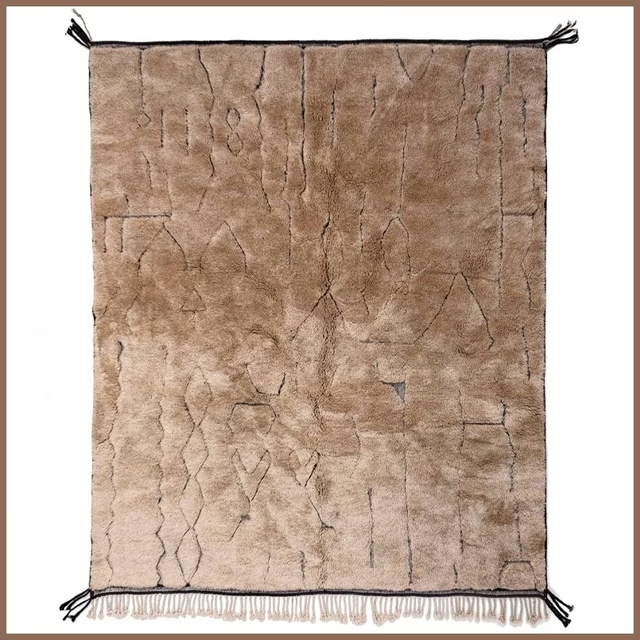
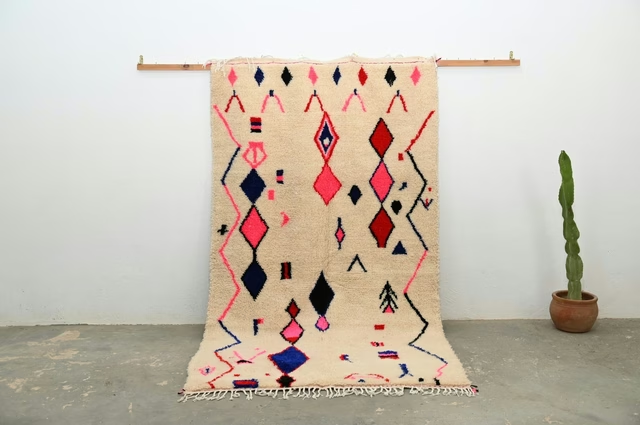
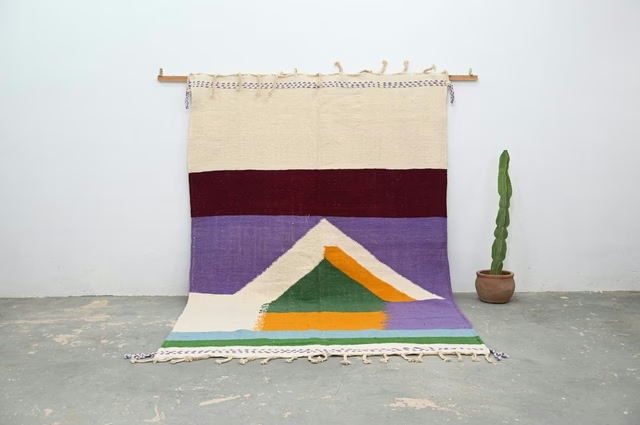
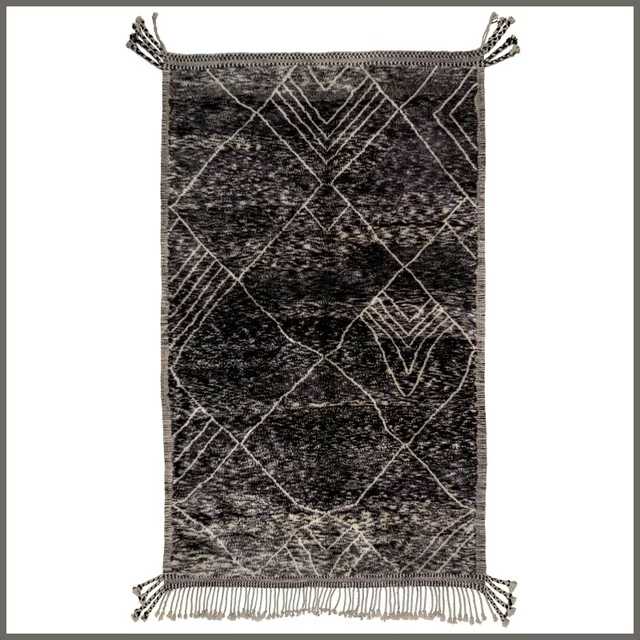
Currently in our collection
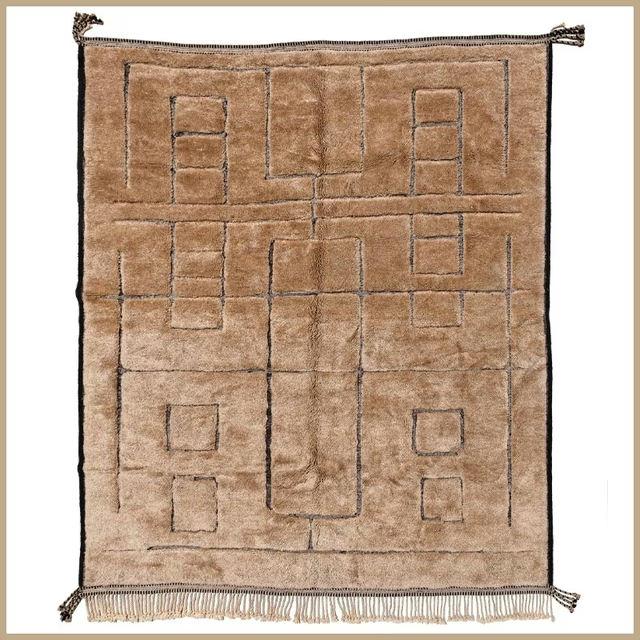
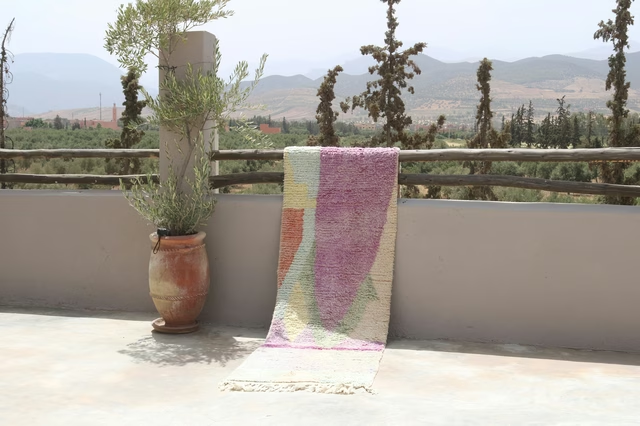
Start with the wool
Good rug wool is springy. Press the pile flat with your palm and let go: it should rise again at once. It has a soft sheen, not a glassy shine, and a slightly waxy feel from lanolin, the natural grease that helps wool shed dirt and water. Long fibres spun into a firm, even yarn wear for decades.
Poor wool is the opposite. It feels dry or harsh, stays flat where you pressed it, and gives off dust. Often it is short fibre recovered from tanneries, or wool stripped of its lanolin by aggressive washing. Check the label as well. A rug sold as wool should be wool in the pile. Viscose, sold as art silk or bamboo silk, looks rich when new and mats and marks at the first spill.
See how the pile is held
Turn the rug over. This single look tells you more than any description. In a hand-knotted rug you see the pattern again on the back, built from rows of small knots that are never perfectly regular, and the fringe is the end of the warp threads, part of the structure. Nothing is glued, and a damaged area can be reknotted.
A hand-tufted rug shows a sheet of cloth on the back, glued on to hide the latex that holds the tufts. It can look excellent from above, but its life is limited by the glue. A machine-woven rug shows a pattern on the back in dead-straight, identical rows, with a sewn-on fringe or none. Each has its place. Only one of them is built to be repaired and handed on.
Density: why knot count misleads
Knots per square inch measure how fine a drawing a rug can carry. For a curvilinear Persian or silk carpet that is central, and a high count means months of extra work. Applied to a Berber rug it is the wrong ruler. These rugs are made with thick yarn and large knots by design, for warmth and depth, and their count is low even in the best pieces.
Judge fullness directly. Push your fingers down into the pile: in a dense rug it is hard to reach the base. Fold a corner back on itself and look into the bend. If you see mostly wool, the rug is full. If the foundation grins through in wide rows, the pile is sparse and will flatten. Weight is a fair guide as well: for the same size and pile height, the heavier rug holds more wool.
Dye and colour
Part the pile and look at a tuft from tip to base. In a well-dyed rug the colour is the same all the way down. If the tip is strong and the base pale, the colour was applied to the surface and will wear off with the tips. Rub a damp white cloth firmly over the darkest colour. A trace is acceptable in a new rug; a clear stain means the dye will run when the rug is cleaned.
Slight bands of lighter and darker shade within one colour are not a fault. In hand-dyed, hand-spun wool they come from the yarn taking dye unevenly, and they give a field its life. A surface that is perfectly uniform and very shiny is more often a sign of machine yarn or of a chemical wash that polishes the wool and shortens its life.
Edges, ends and how it lies
Look along the two long sides. They should be firmly bound and reasonably straight, without loose loops or gaps. The ends should be secured so that the last rows of knots cannot slip off the warps. Lay the rug on a flat floor: gentle irregularity is the signature of handwork, but ridges, a corner that will not stay down or a rug that is clearly wider at one end will not improve.
A hand-made rug is never geometrically exact, and a difference of an inch or two between the ends is ordinary. This is why careful sellers give the measured size of each piece and not a nominal one. If only a round catalogue size is quoted for a rug presented as hand-knotted, ask for the real dimensions.
Judging from photographs
Online you cannot press the pile, so ask the pictures to do the work. A trustworthy listing shows the whole rug from above and a close view of the pile, and ideally the back and the edges. It states the fibre, the construction and the measured size of that specific piece. Photographs of the actual rug matter most with hand-made work, where no two pieces are alike.
The rugs we sell are knotted by hand in wool, and every listing shows the individual piece with its own measurements. We do not quote knot counts, for the reason given above. What each page does give is the style the rug belongs to, its colours and pattern, and its exact size. Delivery is free worldwide, duties and taxes included.
What you can verify about us
- Origin
- Made in MoroccoHand-knotted Berber rugs from the Atlas regions. Every rug is one of a kind.
- Construction
- Hand-knotted woolVerified at every stage — never machine-tufted.
- Delivery
- Duties includedFree shipping; import duties and taxes are included in the price.
- Returns
- 14 daysIn condition received, full refund of the purchase price.
Frequently Asked
Questions
- What is the best wool for a rug?
- Long-staple wool that keeps some of its lanolin, spun into a firm yarn. It springs back when pressed, has a soft sheen and resists soiling. Mountain breeds are valued for exactly that.
- Are hand-knotted wool rugs better than hand-tufted ones?
- In durability and repairability, yes. Knots are tied into the foundation and can last generations, while tufts depend on glue that ages. A tufted rug can still be a reasonable choice for a few years of use.
- Does a higher knot count mean a better rug?
- Only within one type. It matters for fine Persian and silk carpets. Berber and other village rugs use thick yarn and large knots on purpose, so judge them by wool and fullness.
- How can I tell if a rug is real wool?
- Wool is springy, softly lustrous and slightly waxy. Synthetic pile feels slick, and viscose is very shiny and limp. A burnt wool fibre smells of singed hair and leaves a crushable ash, while synthetics melt into a hard bead.
- How long does a high-quality wool rug last?
- A hand-knotted wool rug that is vacuumed gently, turned now and then and kept from moths lasts for decades and is commonly passed on. Glued and machine-made rugs wear out much sooner.
Sources & References
What this page rests on
- 1. Atlas Wool Estate Records
- 2. Master Weaver Quality Standards

The person behind the piece
“Before you buy, I’ll send you a video of the actual rug in natural light — not a stock photo. I answer the messages myself.”
I’m Youssef. I started ARINID because this market is full of middlemen and machine-made imitations sold as the real thing — and I grew up close enough to the looms to know the difference.
Every piece we list is one of a kind, hand-knotted in Morocco. If you want to talk through sizing for your room, I’m on the other end of the message. A rug at this level is a thirty-year decision. You should be able to look the person selling it to you in the eye.
Youssef
Founder, ARINID
The next step
See every rug we currently offer
Each piece is hand-knotted in Morocco and delivered to your door, with shipping, duties and taxes included.